How to Clean a TV Screen Without Damaging the Panel
A new television is the most expensive single display surface in most homes, and the cleaning advice that works for a bathroom mirror destroys it. The difference is a plastic coating that dissolves in alcohol and scratches under paper towel, and once it is gone the glare never goes away.
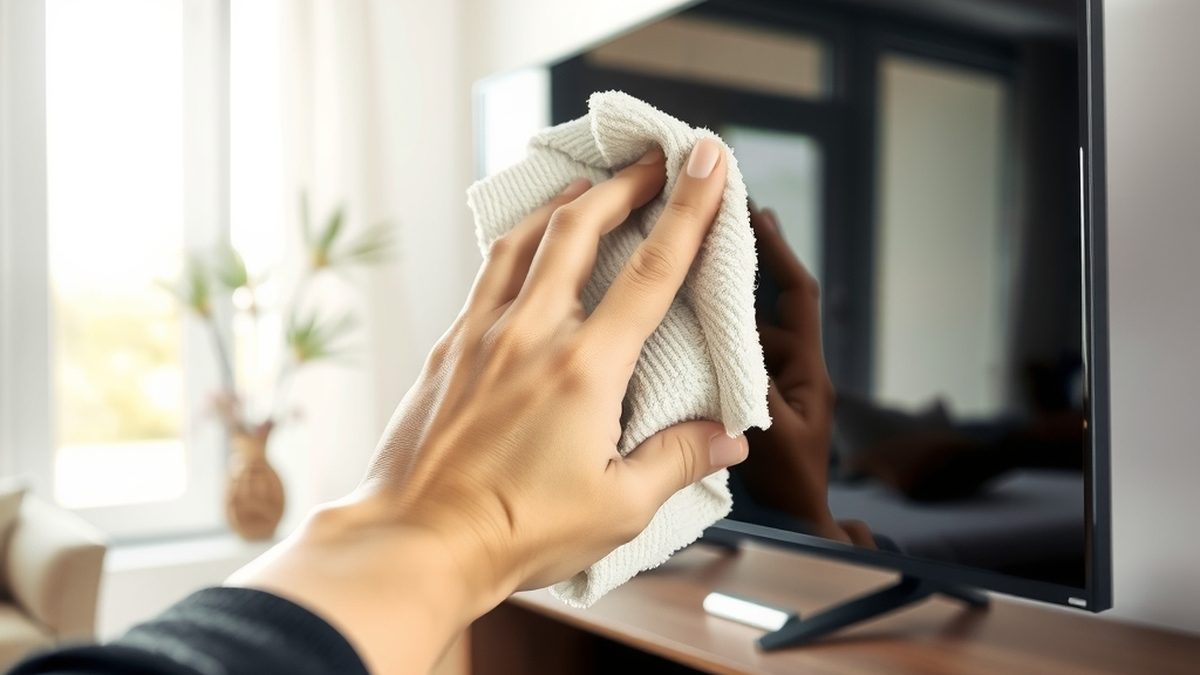
Illustration generated by Nexulab
- Modern TV and monitor screens have an anti-glare plastic coating, not bare glass. Glass cleaner, alcohol, ammonia and even dish soap degrade or strip this coating permanently.
- The only safe cleaning liquid for most screens is distilled water, applied to the cloth and never to the screen directly, using no more moisture than a lightly damp cloth can hold.
- The cloth matters as much as the liquid. Paper towels and kitchen cloths scratch the coating. A clean, dry microfiber cloth is the only tool that lifts dust and oils without abrasion.
- Stubborn smudges like fingerprints and food splatter need patience, not pressure. A second pass with a barely damp microfiber cloth does more than a hard rub with the wrong material.
- Screen manufacturers publish cleaning instructions specific to each model. If the manual says to use nothing but a dry cloth, using anything else voids the warranty on the panel.
Television screens have a secret that the marketing does not advertise: the surface you touch is not glass. It is a thin plastic layer with an anti-glare finish, applied over the panel during manufacturing, and it is fragile in ways that ordinary glass is not. Glass cleaner, kitchen towel, and the cloth from the bathroom shelf — three items found in almost every home — are enough to destroy it.
The damage accumulates silently. A bottle of window spray used once a month on the TV leaves no visible mark the first time, or the fifth. Then one day a patch of the screen looks slightly cloudier than the rest, or a streak will not wipe away, or reflections seem brighter in one corner than another. By the time the damage is visible, the coating is gone for good. The panel still works, but the viewing experience does not recover.
None of this needs to happen. Cleaning a TV screen safely is neither expensive nor complicated. It requires exactly two items — a microfiber cloth and distilled water — and one rule: less is always more. This article explains why television screens are different from other glass surfaces in your home, what destroys them, and how to clean a TV screen so that it stays new-looking for the life of the television.
Why a TV screen is not a window
A window is a single sheet of glass, chemically stable and mechanically hard. You can clean it with ammonia, alcohol, vinegar, abrasive cloths and enough pressure to lean on, and unless you crack it, the surface stays the same.
A flat-panel television screen — whether LED, OLED, QLED or LCD — is a layered structure. The outermost layer in most consumer televisions is a polarising film or an anti-glare coating made of plastic polymers. Its job is to reduce reflections, deepen blacks and improve contrast by controlling how light enters and leaves the panel. It is chemically sensitive and mechanically soft.
The solvents in glass cleaners — ammonia, isopropyl alcohol, ethanol — break down the polymer chains in the coating. The first applications weaken the surface; repeated ones dissolve it. The result is a patch of the screen that reflects light differently from the rest, and it cannot be buffed out because the damage is chemical, not cosmetic.
The same vulnerability exists on laptop screens, desktop monitors, tablets and smartphones. The cleaning advice published by LG for its television panels is explicit: use a dry, soft cloth, and if a damp cloth is necessary, use plain water with no additives and apply it to the cloth, not the screen.
What destroys a screen over time
Paper towels and kitchen cloths might feel soft to your hand, but at the microscopic level they are abrasive. A television’s anti-glare coating has a hardness closer to plastic than to glass, and repeated wiping with paper towel leaves a network of fine scratches that scatter light. The effect is subtle at first — the screen looks slightly hazy — and it worsens as more scratches accumulate.
Household cleaning sprays cause chemical damage. The active ingredients in window cleaner, multi-surface spray and even some “screen cleaning” kits include:
| Substance | Found in | What it does to the screen |
|---|---|---|
| Ammonia | Glass cleaner, multi-surface spray | Dissolves anti-glare polymers; damage is cumulative |
| Isopropyl alcohol | Disinfectant sprays, lens wipes | Strips the coating faster than ammonia; some brands use it in “screen cleaner” — avoid those too |
| Acetic acid (vinegar) | Natural cleaning mixes | Mildly acidic; repeated use etches the plastic surface |
| Sodium lauryl sulfate | Dish soap | Surfactant residue leaves a film that attracts dust and is hard to remove without water |
Even products sold as “screen safe” deserve scrutiny. Some contain mild solvents that a manufacturer’s warranty specifically excludes. If the manual says to use a dry cloth, using anything else — even a product labelled for screens — can void coverage. The safest approach is to ignore the cleaning aisle entirely and use what the manufacturer recommends, which in most cases is nothing more than water.
How to clean a TV screen safely
The method has four steps. It takes two minutes and uses nothing you do not already own.
1. Turn the screen off. A dark screen makes dust, fingerprints and smudges visible. A powered-on screen hides them behind brightness and colour. Turn the television off at the set, not just the remote, and wait a few minutes for the panel to cool if it has been running.
2. Dust with a dry microfiber cloth. Fold a clean, dry microfiber cloth into quarters and wipe the screen in one direction — top to bottom or left to right, whichever feels natural. Do not wipe in circles: circular motion grinds any trapped dust particles against the coating rather than lifting them off. Use the weight of the cloth and no added pressure. This step removes loose dust and light fingerprint oil in most cases, and for a screen that is not visibly smudged, it is the only step needed.
3. For smudges, use a second damp cloth. If fingerprints, food splatter or a child’s handprint remain after dry dusting, take a second clean microfiber cloth and dampen one corner with distilled water. Wring it out thoroughly so that no water drips. Wipe the smudge gently in one direction. Then immediately — before the water dries — go over the same area with the dry cloth to absorb any remaining moisture. Drying the water off is what prevents mineral spots and streaks.
4. Never spray the screen directly. Liquid applied straight to the screen runs down the surface and pools at the bottom bezel, where it can seep behind the frame and reach the electronics. Even distilled water can short a circuit if it reaches the wrong place. Always apply liquid to the cloth, not the panel.
The microfiber cloths themselves need care. Wash them without fabric softener, which coats the fibres and makes them less absorbent and more likely to smear. Air-dry them if possible; dryer sheets leave the same residue. And do not use the same cloth for the television that you use for wiping kitchen counters: cross-contamination transfers grease and cleaning product residue straight onto the screen.
The screen cleaning products to avoid
Shops sell cleaning kits marketed specifically for televisions, monitors and screens. Many are safe. Some are not. The label is not a guarantee: there is no regulatory standard for “screen safe,” and a brand can use the phrase while selling a solution that contains alcohol or ammonia at a low concentration.
Pre-moistened screen wipes are convenient but often contain isopropyl alcohol as a fast-drying agent. Even at low concentration, repeated use degrades the coating. The convenience is not worth the cumulative damage.
Microfiber cloths bundled with a spray bottle are a red flag if the spray is anything other than distilled water. If the bottle contains a coloured or scented liquid, it almost certainly includes solvents or surfactants that the television manufacturer would not approve.
The safest cleaning kit is the one you assemble yourself: two fresh microfiber cloths and a small spray bottle of distilled water. It costs less than any commercial kit and contains nothing that can harm any screen, regardless of brand or coating type.
The same restraint that applies to a television screen applies to other glossy surfaces in the home. Cleaning windows without streaks involves the same principle of controlling moisture and using the right cloth; the guide on streak-free window cleaning covers that in more detail. The difference is that a window survives a mistake. A television screen might not.
What to do about speakers and vents
Dust gathers on speaker grilles, ventilation slots and the ports on the back of the television just as it does on the screen. The difference is that these surfaces can tolerate a vacuum cleaner with a soft brush attachment; the screen cannot.
Use the brush attachment of a vacuum — ideally a handheld one with low suction — to lift dust from the speaker mesh, the air vents and the cable ports at the rear. Keep the nozzle a few centimetres from the surface; do not press it against the television. Compressed air cans work for ports but can blow dust deeper into the chassis if used carelessly, so angle the nozzle away from the body of the set.
The screen itself should never come into contact with a vacuum nozzle, a brush or anything other than the microfiber cloth. The risk is not just scratching: static electricity from a vacuum brush can damage the panel’s electronics even if the surface looks fine.
When the screen has been damaged
If a patch of the screen already looks cloudy, streaky or more reflective than the rest, the anti-glare coating has been compromised. There is no home remedy that restores it. Polishing compounds designed for car headlights or phone screens will make the problem worse by removing more of the remaining coating.
The options at that point are limited. If the damage is in a corner or edge and is not visible during normal viewing, the pragmatic choice is to live with it and switch to dry-cloth-only cleaning from now on. If the damage is central and distracting, a professional television repair service can sometimes replace the polarising film, but the cost is usually high enough that it only makes sense for premium sets still under value.
Prevention is the whole strategy here. A microfiber cloth costs a few dollars and lasts years. Distilled water costs even less. Using them from day one keeps the screen intact for the life of the television, and the one habit that matters — never reaching for the glass cleaner — is the easiest one to adopt because it costs nothing. The alternative is a screen that degrades slowly over months and cannot be repaired, which is a high price for a shortcut that did not even save time.
The same logic — use the right method for the surface, not the method that works on something else — applies across household cleaning. Hardwood floors need a specific approach that a tile-floor routine destroys, just as a television screen needs a specific approach that a window-cleaning routine ruins. The guide to cleaning hardwood floors covers that parallel: two delicate surfaces, two sets of rules, and the same mistake of assuming one method fits all.
Frequently asked questions
Can I use glass cleaner on my TV screen?
No. Glass cleaner contains ammonia or alcohol, both of which dissolve the anti-glare coating on modern flat-panel screens. The coating is a thin layer of plastic, not glass, and once it breaks down the screen develops a permanent cloudy or streaky patch that cannot be repaired. The damage is not covered by warranty because it is user-caused. The same applies to eyeglass cleaner, kitchen degreasers, and multi-surface sprays. If you have used glass cleaner once or twice and see no damage yet, stop now: the coating weakens over multiple exposures before the visible damage appears.
Why does my TV screen get streaks when I clean it?
Streaks on a TV screen usually come from three things. Too much liquid pools in the gaps and leaves mineral residue when it dries. The wrong liquid — anything with solvents or surfactants — leaves a film that the coating cannot shed. And a dirty cloth redeposits oils and dust rather than lifting them away. The fix for all three is the same: switch to a clean, dry microfiber cloth and use no liquid at all unless the smudge is greasy, in which case use a second cloth barely dampened with distilled water and go over the area again with the dry one immediately after.
Can I use a damp cloth on my TV screen?
Yes, but with two strict conditions. The cloth must be damp, not wet — wring it out until no water drips and it feels barely cool to the touch. And the water must be distilled, not tap water, because tap water contains minerals that leave spots and can etch the coating over time. Apply the water to the cloth, never directly to the screen, because liquid applied to the screen runs down into the bezel and can reach the electronics at the bottom edge. This is the same principle behind streak-free window cleaning: it is about controlling where the moisture goes.
How do I remove fingerprints from a TV screen?
Fingerprints are oil-based, so a dry cloth alone will smear them instead of lifting them. Use a microfiber cloth barely dampened with distilled water, wipe the fingerprint in a single direction, and then go over the area with a second dry microfiber cloth to remove any remaining moisture before it dries. Do not rub in circles: circular motion spreads the oil across a wider area. Do not press harder: the oil needs to transfer to the cloth, and pressure does not speed that up. If the fingerprint remains after two passes, it may have etched into the coating slightly, and further rubbing risks making it worse.
What if my TV screen has a matte finish instead of glossy?
Matte screens have a more textured anti-glare coating that hides reflections by scattering light. That texture also traps dust and oil more stubbornly than a glossy panel, so the temptation to press harder or use a cleaning product is stronger. Resist it. The same rules apply: a dry microfiber cloth for dust, a barely damp one for oily smudges, and nothing else. The matte coating is if anything more vulnerable to chemical damage because its surface area is larger. Some manufacturers of matte monitors and TVs specifically warn against any liquid at all, so check the manual before using even distilled water.