How to Get Rid of Ants, and Why They Keep Coming Back
A line of ants across the kitchen counter is not the problem. It is a symptom. The problem is a colony of thousands somewhere nearby that has decided your house is a food source.
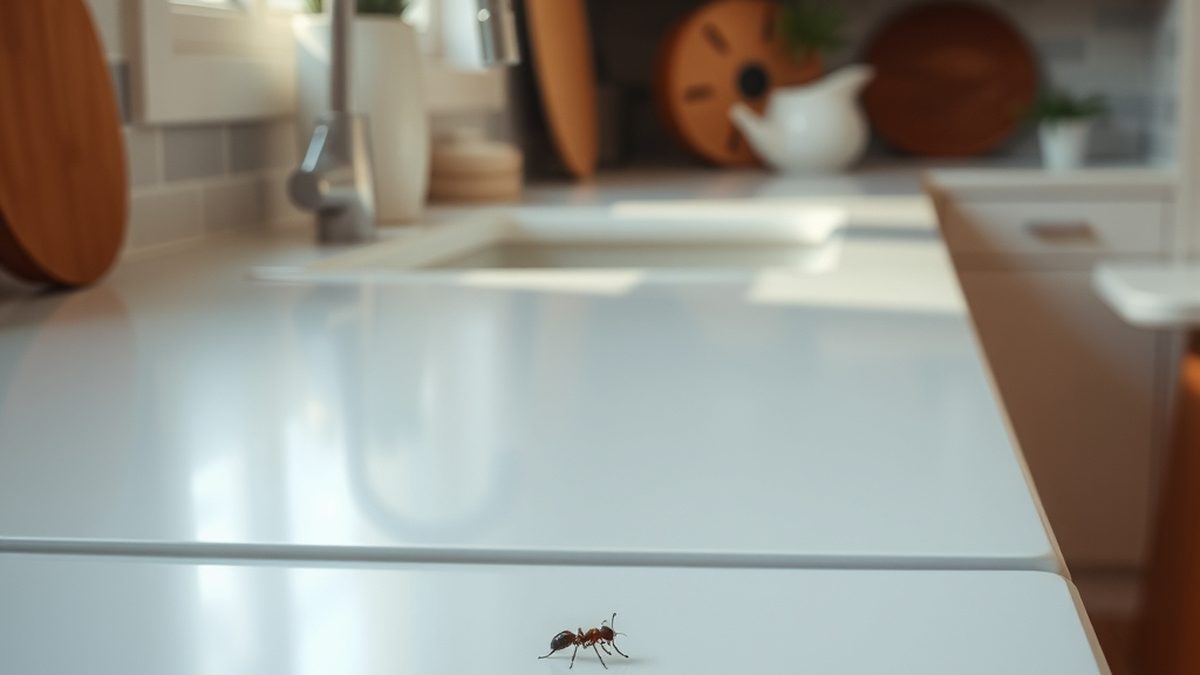
Illustration generated by Nexulab
- Killing the ants you see with spray removes the symptom, not the cause. The colony survives and sends new scouts within hours.
- Ants follow chemical trails laid down by scout ants. Cleaning those trails is what stops reinforcements from arriving.
- Baits work differently from sprays: they exploit the ant's own food-sharing behaviour to deliver slow-acting poison back to the colony, including the queen.
- Entry points are almost always cracks around windows, gaps under doors, or holes where pipes and cables enter the wall. Closing them is a permanent fix that costs very little.
- What attracts ants in the first place is usually a food source you have stopped noticing: a smear of honey on a jar, crumbs behind the toaster, an unrinsed pet food bowl.
An ant trail is a form of communication. The ants you see are not wandering randomly; they are following a chemical map drawn by a scout that found something worth reporting. Kill those ants and the map remains. The colony sends fresh scouts along the same route, and within hours the counter is full again.
The real fix is to interrupt the conversation between scout and colony, and then to make your house stop sounding interesting in the first place. That takes three things: cutting the trail, deploying bait that reaches the nest, and closing entry points permanently. This article covers all three, plus what attracts ants in the first place and which common advice wastes your time.
Why ants enter the house
Ants live in colonies that range from a few hundred individuals to tens of thousands, depending on the species. The colony is a superorganism: individual ants serve functions — foraging, nursing, defence — and their behaviour is coordinated by chemical signals rather than a central decision-maker.
A scout ant leaves the colony to search for food. When it finds something — a drop of jam, a crumb, a smear of grease — it eats a small amount and returns to the nest, laying down a pheromone trail as it goes. Other workers detect the trail, follow it to the source, and reinforce the path on their way back with more pheromone. The more workers that travel the route, the stronger the trail becomes, and the more workers it recruits. That is how a single scout becomes a line of hundreds within hours.
The food sources that attract ants are often small enough that you stop noticing them: honey crystallised around the lid of a jar, grease settled behind the cooker knobs, the residue inside an unrinsed pet food bowl. Ants are not judging your housekeeping. They are responding to chemical signals you cannot smell, at concentrations far below what the human eye registers as dirt.
Why spraying the trail does not work
Household insect sprays kill on contact. They also leave a chemical residue that ants avoid. That sounds useful — you kill the ones you hit and make the area repellent — but it does not solve the problem for two reasons.
First, the colony does not die. Only the foragers on the trail are exposed. The queen, the brood and the thousands of workers still inside the nest are unaffected and will continue to produce new foragers.
Second, ants are good at rerouting. When a trail becomes blocked or repellent, scouts explore around the obstacle and establish a new path, often through a different entry point. The spray pushes the problem to another part of the house rather than ending it.
Sprays have a role: they stop an active indoor trail immediately, which matters if you have guests arriving or if the trail is across a food preparation surface. But they are a holding action, not a solution. Use them while bait is working, or after sealing an entry point to clear the stragglers, but do not mistake a clean counter for a solved problem.
Cutting the trail: what actually works
The trail is the colony’s navigation system. Erase it and the workers lose their way. The most effective way to do that is physical removal with soap and water.
Washing-up liquid and warm water on a cloth or sponge removes the pheromone trail from the surface. The soap breaks down the lipids that carry the chemical signal. Plain water is less effective because the pheromones are not water-soluble; the detergent is what does the work. Wipe along the entire visible trail, then extend a few feet beyond both ends in the direction the ants were travelling, because the trail continues outside your line of sight.
Vinegar, lemon juice and essential oils are often recommended as natural alternatives because ants dislike strong scents. They can disrupt a trail temporarily, but they evaporate and the effect fades. They also do nothing about the ants still inside the wall cavity or under the floor searching for an alternative route. Use them if you have nothing else, but do not expect them to end the infestation.
Once the trail is cleaned, the next move is bait.
How ant baits work, and how to use them properly
A bait combines an attractive food base with a slow-acting insecticide. The food must be appealing enough that workers carry it back to the nest. The poison must act slowly enough that the worker delivers it before dying. If it acts too fast the worker dies en route and the colony learns to avoid the bait.
The delivery mechanism is trophallaxis — the mouth-to-mouth exchange of liquid food that ants use to distribute nutrition throughout the colony. A worker that consumes bait shares it with other workers, who share it with larvae, who share it with the queen. Over days, the insecticide reaches every member of the colony that is fed through this network.
The most common bait failure is offering the wrong food. Ant colonies shift their nutritional preferences depending on what the colony needs at that moment. A colony rearing larvae needs protein. A mature colony in maintenance mode needs carbohydrates. If you put down a sugar-based bait and the ants walk past it, they are probably looking for protein or fat instead. Try a different bait formulation. Some species — particularly carpenter ants and pharaoh ants — have strong and consistent preferences, but most common household ants will accept either depending on the season.
Place baits along active trails but not on top of them, and never spray insecticide near a bait station. The spray residue contaminates the bait and makes ants avoid it entirely. Put the bait where you see traffic and wait. It takes days, sometimes up to two weeks. Do not move it after a day because you do not see ants feeding. The colony takes time to switch its foraging effort to a new food source.
Closing the entry points
Ants enter the house through physical gaps, and those gaps are almost always small: a crack in the window frame, a gap under an external door, the space around a pipe where it passes through the wall, a vent without a fine mesh.
Finding the entry point is a matter of following the trail backwards. Watch where the ants appear and trace the line in reverse. It almost always leads to a wall edge, a windowsill or a door frame. Once you find it, the fix is straightforward:
| Entry point | What to use | Notes |
|---|---|---|
| Gap under door | Door sweep or rubber strip | Self-adhesive ones work for most doors; screw-in for heavy use |
| Crack in window frame | Silicone caulk | Flexible, paintable, waterproof. Clean the surface first |
| Pipe penetration | Expanding foam or copper mesh | Foam fills large gaps; copper mesh in small holes because ants do not chew through metal |
| Baseboard gap | Acrylic caulk | Paintable, easier to apply neatly than silicone |
| Vent or weep hole | Fine stainless steel mesh | Cut to size and glue or staple. Do not block entirely; vents exist for a reason |
Sealing entry points is the only permanent part of the solution. Baits kill the colonies that already know about your house. Sealing stops new ones from discovering it.
What attracts ants and how to stop it
Ants are drawn to three things: food, water and shelter. Of the three, food is the one you control most directly. The foods ants target most often in a kitchen are:
Sugars and syrups. Honey, jam, maple syrup, soft drinks, fruit juice. The sticky residue left on the outside of a jar or bottle is enough to attract a scout. Rinse containers before putting them in the recycling bin, and wipe down the surfaces where they sat.
Grease and protein. Cooking oil, butter, meat juices, pet food. Ants seeking protein will find a splash of grease behind the cooker faster than they will find a sugar spill. Clean cooker tops and the area behind them regularly. Do not leave pet food bowls on the floor between meals.
Crumbs and debris. The toaster tray, the gaps between counter and cooker, the floor under the dining table — these are the zones that accumulate crumbs you stop seeing. A weekly sweep of the crumb-catching zones reduces the odds of a scout finding something worth reporting.
Water matters too. Some species, particularly pavement ants, enter houses during dry spells searching for moisture. A dripping pipe under a sink or condensation on a window frame is enough to attract them. Fixing minor leaks eliminates a second draw.
The principle is the same one that applies to other household pests: removing the attractant is easier than fighting the insect. A house that smells like food to an ant will keep attracting ants regardless of how many you kill. The article on getting rid of fruit flies covers a parallel problem — a different insect, but the same logic: find the source, remove it, and the visible insects become the last of the problem rather than the first of the next wave.
The ant species that matter in a home
Not all ants respond to the same approach. Knowing which species you are dealing with lets you choose the right bait and predict where they will nest.
Odorous house ants are the most common indoor ant in North America. They are small, dark brown or black, and smell of rotten coconut when crushed — hence the name. They prefer sugar and nest in wall voids, under floors and in insulation. Sugar-based baits work well.
Pavement ants are slightly larger, dark brown, and nest under concrete slabs, in foundation cracks and between paving stones. They eat almost anything but prefer grease and protein when larvae are present. You often see their nest as a small pile of displaced soil at the edge of a driveway or patio.
Carpenter ants are large, black, and nest in damp or damaged wood rather than eating it — they excavate galleries but do not consume the wood itself. Finding carpenter ants indoors, especially winged ones, is worth taking seriously because it points to a moisture problem somewhere in the structure. They prefer protein baits.
Pharaoh ants are tiny, pale yellow, and are among the hardest to eliminate because a single colony can have multiple queens and can split into satellite colonies when threatened. Spraying pharaoh ants makes the problem worse by triggering colony budding. Baits are the only effective approach.
Sugar ants is a catch-all term people use for any small ant attracted to sugar, but it usually refers to odorous house ants or pavement ants. The distinction matters because bait preference differs.
If you are unsure what species you are looking at, take a clear photo and compare it to extension service guides. The US Environmental Protection Agency provides identification and treatment guidance organised by species, which is more reliable than a general search result.
When to call a professional
Most household ant problems resolve with bait, trail cleaning and sealing. A professional is worth considering when:
- You have carpenter ants indoors, because the nest may be in structural wood and the moisture source needs diagnosing.
- You have pharaoh ants, because colony budding from misapplied treatment spreads the infestation.
- Baiting for three weeks has produced no reduction in visible ants.
- The ants are entering from multiple points on different sides of the house, suggesting several colonies.
- You have a known allergy to ant stings and cannot safely deploy bait stations yourself.
A competent pest control professional will identify the species, locate the nest if accessible, and apply a targeted treatment rather than spraying everywhere. If someone arrives and reaches for a spray can before looking for the trail, that is the wrong person.
Cleaning the entry point after the colony is gone is still your job. No treatment stops new ants from finding your house next season. What stops them is a sealed door frame and a kitchen that does not smell interesting. The same restraint that keeps a wood floor intact — using the right cleaning method for the material — applies to pest control: using the right tool for the species and avoiding the impulse to spray indiscriminately is what makes the fix permanent.
Frequently asked questions
Why do ants suddenly appear in a clean house?
Cleanliness reduces the odds but does not eliminate them. A single scout ant that finds a crumb behind the toaster or a drip of syrup on a jar lid lays down a pheromone trail on the way back to the colony. The colony then mobilises hundreds of workers along that trail within hours. What feels sudden is actually the moment the trail reaches enough workers to become visible to you. The house did not become dirty overnight — a scout found something, and the colony responded.
Does killing ants with spray actually work?
For the ones you hit, yes. For the colony, no. Contact sprays kill on contact and leave a residual that repels ants from that spot, but the colony simply routes traffic around it. Within a day or two you will find them entering from a different crack, following a new trail. Sprays are useful for stopping an active trail immediately, but they do nothing to eliminate the source. Think of them as a temporary measure while you deploy a bait or seal the entry point.
How do ant baits work?
A bait is a mixture of an attractive food and a slow-acting insecticide. Worker ants carry the bait back to the colony, where it is shared through trophallaxis — the mouth-to-mouth exchange of food that ants use to feed each other, including larvae and the queen. Because the poison acts slowly, the workers do not die before making the delivery. It takes a few days to a couple of weeks for the colony to collapse. The key is using the right bait for the species: some ants prefer sugar, others prefer protein or fat, and offering the wrong one fails before it starts.
What is the best natural way to get rid of ants?
Diatomaceous earth — food-grade, not pool-grade — is a fine powder made of fossilised algae. At a microscopic level the particles are sharp and abrasive, and they damage the waxy outer layer of an ant's exoskeleton, causing it to dry out and die. It is not instant, but it is mechanical rather than chemical, so ants cannot develop resistance. Apply a thin line along entry points and trails. The catch is that it stops working when wet, so it is for indoor or sheltered use only. Vinegar and essential oils can disrupt trails temporarily but have no effect on the colony.
How do I stop ants from coming back?
Three things, in order. First, remove the invitation: store all food in sealed containers, wipe surfaces of crumbs and sticky residue, and rinse pet bowls after meals. Second, block the entry points with silicone caulk around windows and doors, expanding foam where pipes enter walls, and door sweeps at the bottom of external doors. Third, eliminate the colonies that already know about your house by deploying baits near trails but away from areas you clean regularly. None of these steps is expensive or complicated. Together they turn your house from a reliable food source into a dead end that scouts do not bother reporting back.