How to Choose the Best Dog Food for Labradors
No breed is more famous for appetite, and none pays a higher price for it. With Labradors, the feeding decision that matters most is not which bag you buy.
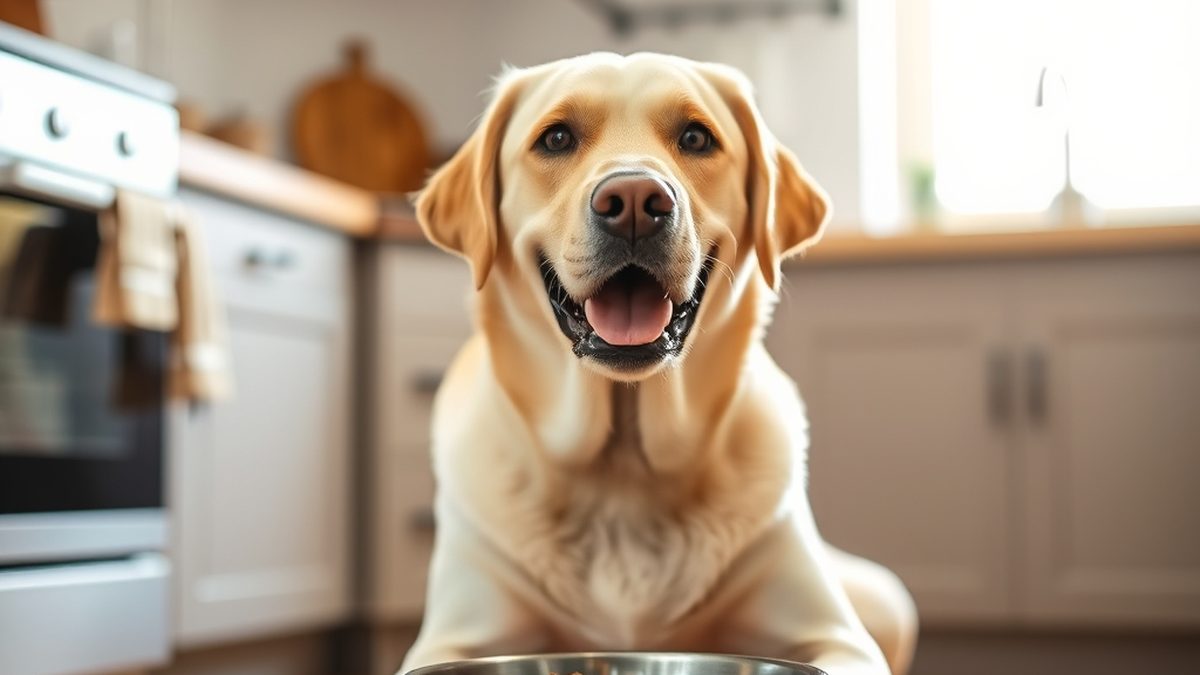
Illustration generated by Nexulab
- Portion control matters more than brand for this breed. A Labrador at a healthy weight outlives an overweight one, and it is not a small difference.
- Labradors are known for a strong food drive, so a dog acting hungry is not evidence that it needs more food.
- Choose a large-breed formula while they are growing, because controlled growth protects hips and elbows.
- Ignore the feeding chart as an instruction and treat it as a starting point. Adjust to the dog you can feel under your hands.
- Joint health, coat condition and weight are the three things worth watching, and all three respond to how much you feed.
Search for the best dog food for Labradors and you will get brand rankings. Ten bags, ordered one to ten, as though the bag were the decision.
For this breed, it mostly is not. The decision that changes a Labrador’s life is how much ends up in the bowl.
That sounds like a dodge. It is not. Portion control is the single highest-leverage thing a Labrador owner does, and no premium bag compensates for getting it wrong.
This is general information, not veterinary advice. Your vet knows your individual dog, and body-condition assessment is something worth doing together at least once so you know what you are feeling for.
Why this breed is different
Labradors have a reputation for appetite that is not folklore — it is the thing vets bring up with Labrador owners more than almost any other breed-specific concern.
The practical consequence is straightforward and slightly cruel: a Labrador acting hungry is not evidence of hunger. For most breeds, persistent food-seeking is a reasonable signal. For this one, it is closer to a constant.
Which means the normal feedback loop breaks. You cannot feed this dog by reading its enthusiasm, because the enthusiasm does not switch off.
What excess weight actually costs
This is worth being concrete about, because “keep your dog slim” sounds like a nag rather than a decision.
Extra weight on a Labrador loads joints that are already the breed’s weak point. Hip and elbow problems are common in Labradors, and body weight is one of the few contributing factors an owner controls completely. Genetics you inherit; portion size you decide twice a day.
It also compounds. A dog with sore joints moves less, and a dog that moves less gains more. The direction of that loop is set by feeding, not by exercise.
Veterinary nutrition bodies including the WSAVA global nutrition guidelines treat body condition assessment as a routine part of every examination for exactly this reason — it is the measurement that predicts the most.
How to judge the amount, without a scale
Two checks, both done with your hands, both taking about ten seconds.
Ribs. Run your palms along the dog’s sides with light pressure. You should feel the ribs clearly through a thin layer of covering — similar to feeling the back of your own hand. If you have to press to find them, the dog is carrying too much. If they feel sharp and prominent, too little.
Waist. Look down at the standing dog from above. There should be a visible narrowing behind the ribs. Straight sides mean overweight.
Do this fortnightly. It catches drift long before a photograph would, and drift is how dogs get heavy — never suddenly, always a few grams a week.

Now the bag
With portions settled, the food itself becomes a much simpler question. Four things to check, in order.
A complete-and-balanced statement for the right life stage. In the United States this references AAFCO nutrient profiles. It is the least glamorous line on the packaging and the most important: it means the food is formulated to meet established nutritional requirements rather than assembled from appealing ingredients.
Large-breed formulation while growing. For a Labrador puppy this is not optional, and the reasoning is the same one that applies to choosing food for a puppy of any large breed. Large-breed puppy foods control calcium and energy density deliberately, so growth is steady. Fast growth in a large-breed puppy produces the same adult dog with worse joints, and adding a calcium supplement on top works directly against the food you chose.
A named protein source. “Chicken” or “lamb” tells you something. “Meat and animal derivatives” tells you less. This is a modest signal, not a decisive one.
Something you can actually keep buying. A food the dog does well on, that you can find locally at a price you will not resent in eight months, beats a better food you abandon. Consistency has real value with dogs.
What matters less than the internet suggests
Grain-free. Grains are not inherently bad for dogs, and genuine grain allergies are far less common than the shelf space implies. Unless a vet has diagnosed a specific sensitivity, this is positioning.
Ingredient-list order. It is ranked by pre-cooking weight, and fresh meat carries a lot of water. A bag listing fresh chicken first may contain less chicken protein than one listing chicken meal, once both are cooked. The list is not useless, but it will not rank foods for you.
Breed-specific bags. A bag with a Labrador on it is a large-breed food with marketing attached. That is not a criticism — large-breed formulation is genuinely what you want — but you are not missing anything by choosing a well-formulated large-breed food without the portrait.
The American Kennel Club covers the general nutrition side in more depth, and PetMD is reasonable on interpreting labels.
Living with a dog that always wants more
The practical part, because this is where owners struggle.
Weigh the food, do not scoop it. A cup is not a unit of mass and hands are generous. Kitchen scales cost very little and remove the drift entirely.
Count treats as food. Training rewards, chews and the crust of your toast all add up, and they are usually what pushes a carefully measured diet over the line. Take treats out of the daily ration rather than adding them to it.
Slow the eating down, not the amount. Puzzle feeders and slow bowls turn thirty seconds into several minutes. The dog finishes more satisfied on the same food, and gulping less is worth something on its own for a deep-chested breed.
Split the ration. Two or three meals from the same total feels like more to the dog than one.
Get everyone to agree. One family member who feeds by eye undoes everything. This is the most common reason careful feeding fails.
The short version
Choose a complete-and-balanced food, large-breed formula while growing, named protein, available where you shop.
Then stop thinking about the bag and start weighing the portion.
Check ribs and waist fortnightly and adjust by small amounts.
And do not trust the dog’s opinion on whether it has eaten enough. With this breed, that opinion is not information.
The owners whose Labradors reach a comfortable old age are rarely the ones who found a special food. They are the ones who kept the dog lean for twelve years.
For more in this series, see our other pets guides.
Frequently asked questions
How much should I feed my Labrador?
Start with the manufacturer's chart for your dog's target weight rather than current weight, then adjust based on body condition every couple of weeks. You should be able to feel the ribs under a thin layer of fat without pressing hard, and see a waist when you look down from above. Activity level changes the answer considerably — a working retriever and a companion dog of the same size can need noticeably different amounts.
Are Labradors prone to obesity?
They are widely recognised as one of the breeds most likely to gain excess weight, which is why vets raise it so consistently with Labrador owners. Part of that is appetite and part is that owners read persistent food-seeking as genuine hunger. The practical consequence is that free-feeding — leaving a full bowl down — works badly for this breed.
Should a Labrador puppy eat large-breed puppy food?
Yes. Large-breed puppy formulas control calcium levels and energy density so that growth happens steadily rather than in bursts, which matters for a breed prone to hip and elbow problems. A puppy that grows fast becomes the same size adult as one that grows steadily, but with less well-formed joints.
Is grain-free food better for Labradors?
There is no general reason a Labrador needs grain-free food. Grains are not inherently problematic for dogs, and true grain allergies are uncommon compared with how often grain-free is marketed. If your dog has a diagnosed sensitivity, follow your vet's guidance; otherwise this is a marketing distinction more than a nutritional one.
What should I look for on the label?
A statement that the food is complete and balanced for your dog's life stage, a named protein source rather than a vague 'meat' term, and a large-breed formulation if the dog is still growing. Beyond that, the ingredient list tells you less than most people assume, because it is ordered by weight before cooking and moisture makes those weights hard to compare.