Why Does My Cat Bite Me? Reading the Warning You Missed
Cats are described as unpredictable by people who have not learned to read them. The bite is the last step in a sequence that started several seconds earlier.
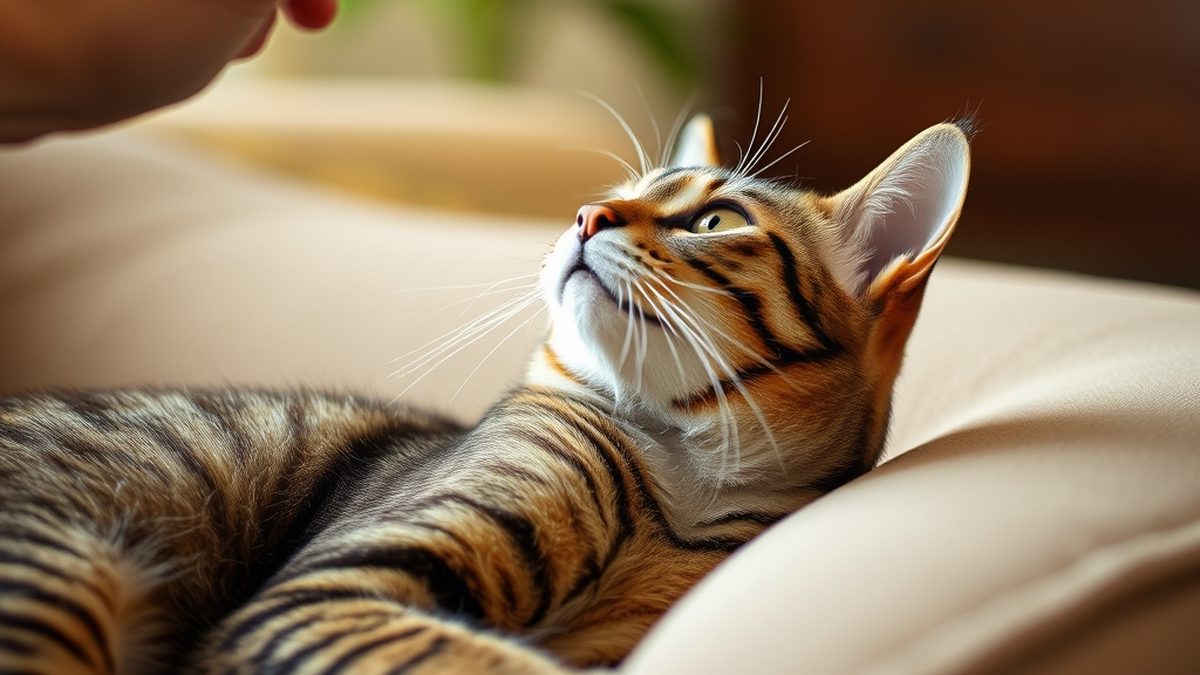
Illustration generated by Nexulab
- Cats almost always signal before biting. The bite feels sudden because the earlier signals are subtle, not because they were absent.
- Overstimulation biting during stroking is the most common kind, and it has clear warnings: tail flicking, skin twitching, ears rotating.
- Play biting comes from kittens that were allowed to use hands as toys. The fix is a toy between you, not a reprimand.
- Redirected aggression, where a cat frightened by something else bites whoever is nearest, is not about you and is not a discipline problem.
- Never punish a bite. It raises the cat's arousal and removes the warnings, which produces a cat that genuinely does bite without notice.
People describe cats as unpredictable. What they usually mean is that they missed the warning.
A cat biting during stroking, or mid-play, or apparently out of nowhere, has almost always signalled first. The signals are quiet — a tail tip moving, skin rippling along the spine, an ear rotating a few degrees — and they last a couple of seconds. Learn them and the same cat becomes entirely predictable.
That is the whole subject. Not how to stop a cat biting, but how to notice it was about to.
This is general information, not veterinary advice. Biting that appears suddenly in a cat that never did it, or that follows being touched in a particular place, can indicate pain and deserves a vet.
The four kinds, and why the difference matters
Like barking in dogs, biting is several behaviours wearing one name, and the right response depends on which you have.
Overstimulation. During stroking. The most common by far.
Play aggression. Usually a young cat, usually hands, usually because hands were the toy once.
Redirected aggression. The cat is aroused by something it cannot reach and bites whoever is nearest. Nothing to do with you.
Pain or fear. A defensive response, and the one that most needs a vet rather than a technique.
Applying the play-aggression fix to an overstimulated cat achieves nothing. Applying a discipline approach to a cat in pain makes it considerably worse.
Overstimulation: the one everyone meets
Your cat jumps on your lap, settles, purrs, and you stroke it. After a while it bites your hand and leaves.
This confuses people because the purring was genuine. It was. The purr was not a contract to continue indefinitely, and the same repetitive touch that felt pleasant at minute one is producing a different response by minute four. Arousal builds.
The warnings, in the order they usually arrive:
- The tail tip starts to flick, then the whole tail
- Skin twitches or ripples along the back
- Ears rotate sideways — the flattened aeroplane position
- The body tenses under your hand
- The head turns toward the hand
- Purring changes pitch, or stops
- Pupils dilate
Stop at the first one and there is no bite. That is not a training programme, it is paying attention for three seconds.
Practical adjustments that reduce it: keep stroking sessions shorter than you think, favour the head and cheeks over the back and the base of the tail, and let the cat leave rather than holding it. A cat that knows it can go usually stays longer.
If you find the transition hard to spot, count strokes. Many cats have a fairly consistent tolerance, and knowing yours is roughly fifteen means stopping at ten.
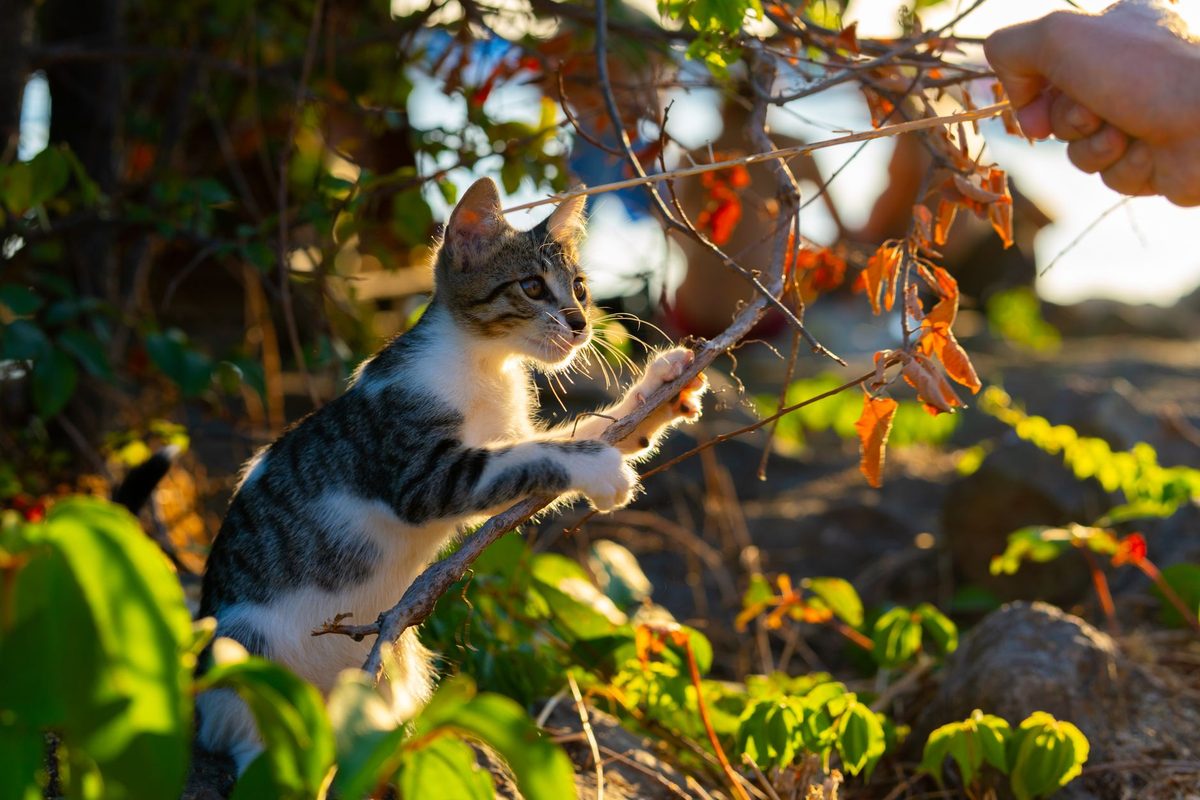
Play biting: your hands were the toy
Kittens learn bite inhibition by playing with littermates. Bite too hard, the game stops, and the lesson lands.
A kitten raised playing with human hands learns something different: hands are prey. That cat grows up and the game does not change, but the teeth do.
The fix is distance, not correction.
Use wand toys, always. Something long enough that your hand is never the target. Fishing-rod toys, a feather on a string, anything that puts thirty centimetres between skin and teeth.
End the game the instant teeth touch skin. Not a reprimand — just stand up and walk away. The game ending is the consequence, and it is the same one the littermates provided.
Give the hunting sequence somewhere to go. Stalk, chase, catch, kill, eat. A play session that ends with a small meal completes the sequence, and cats settle better afterwards.
Two short sessions a day beat one long one, especially for a young cat in a flat.
An under-stimulated indoor cat with no outlet will find one, and you are the most interesting thing available.
Redirected aggression: it is not about you
A cat sees another cat through the window. It cannot reach it. It becomes intensely aroused, and the nearest living thing gets bitten.
This is genuinely not personal, and treating it as disobedience is both unfair and ineffective.
What to do in the moment: nothing. Leave the room. Do not try to soothe the cat — touching an aroused cat is how the second bite happens. Give it twenty minutes alone to come down.
What to do afterwards: address the trigger. Frosted film on the lower part of the window, a curtain, moving furniture the cat perches on to watch. The same principle as blocking a dog’s view of the street: a trigger that never fires needs no management.
The ASPCA cat care resources cover feline aggression in more depth, and veterinary schools such as Cornell University College of Veterinary Medicine publish accessible material on the medical causes behind behaviour changes.
Pain and fear: the one to take seriously
A cat that has never bitten and now does is telling you something.
Worth a vet if:
- Biting started recently with no change in circumstances
- It happens when you touch a particular area
- The cat is hiding more, grooming less, or eating differently
- It comes with other changes — litter box habits, vocalising, posture
Cats conceal illness unusually well, so behaviour is often the first thing that shows. Arthritis in older cats is a common and easily missed cause of sudden intolerance to handling.
Fear biting is different again: a cornered cat that cannot escape will bite as a last option, having already tried hissing, flattening and retreating. The answer is to stop cornering it, not to insist.
What never helps
Punishment. It raises arousal, and arousal is the problem. Worse, a cat punished for tail-flicking and ear-flattening learns to suppress those — and then you have a cat that bites with no warning at all. You will have removed your own early-warning system.
Shouting. Reads as more threat.
Scruffing. Not a discipline tool, and unpleasant for an adult cat.
Pulling your hand away sharply. Fast movement looks like prey, and it tears skin on the way out. Go still instead; most cats release almost immediately when the target stops moving.
Waiting it out. An overstimulated cat does not settle while you keep stroking.
A note on the bites themselves
Cat bites deserve more medical respect than they usually get. The teeth are fine and sharp, so they push bacteria deep and the surface closes quickly over it — which is a good description of how an infection starts.
Wash any puncture immediately with soap and running water. See a doctor if there is spreading redness, swelling, warmth, or if the bite is on a hand or over a joint. This is not alarmism; hand bites in particular are taken seriously in medicine for good reason.
The short version
Your cat is warning you. Tail, skin, ears, tension, head turn. Three seconds, every time.
Stroking bites mean stop sooner, not stop stroking.
Play bites mean a wand toy and a game that ends when teeth appear.
Sudden biting means a vet before a plan.
And never punish it, because the warnings are the most valuable thing your cat gives you.
For more in this series, see our other pets guides.
Frequently asked questions
Why does my cat bite me when I am petting him?
Almost certainly overstimulation. Repeated stroking builds arousal in a way that goes from pleasant to too much, and the transition can be quick. The signals arrive first — the tail begins to flick, the skin along the back twitches, the ears rotate sideways, the body tenses, the head turns toward your hand. Stopping at any of those prevents the bite entirely, which is why the same cat seems fine with someone who reads it.
Why does my cat bite me gently?
Soft, controlled bites that do not break skin are usually social rather than aggressive. Cats groom each other with light nibbling, and some direct that at people they are comfortable with. It can also be a request — a nudge toward the food bowl or the door. The distinction is in the body: relaxed and loose means social, tense and still means you are about to be told off.
How do I stop my cat biting my hands during play?
Stop using your hands as the toy, and be consistent about it. Cats that were played with by hand as kittens learned that hands are prey, and that lesson does not fade on its own. Use a wand toy so there is always distance between your skin and the teeth, and when a bite happens, end the game immediately by standing up and walking away. Withdrawing the fun teaches more than any correction.
Why did my cat bite me for no reason?
There is usually a reason, and often it is not you. Redirected aggression happens when a cat is aroused by something it cannot reach — another cat outside the window, a noise, a smell — and bites whoever is closest. Pain is the other frequent cause, particularly if the bite followed being touched in a specific place. A cat that starts biting when it never did before deserves a vet visit before a behaviour plan.
Should I punish my cat for biting?
No, and it makes things worse in a specific way. Punishment increases arousal and fear, which raises the likelihood of biting rather than reducing it. Worse, a cat punished for its warning signals learns to stop giving them — and then you genuinely have a cat that bites without notice. Remove yourself from the situation instead, calmly and immediately.