The Best Free Alternatives to Adobe Animate
Adobe Animate is the modern name for Flash, and most people still open it for one of two reasons: tweening vector shapes, or rigging characters for cut-out animation. No free tool does both equally well, but each job has a strong answer.
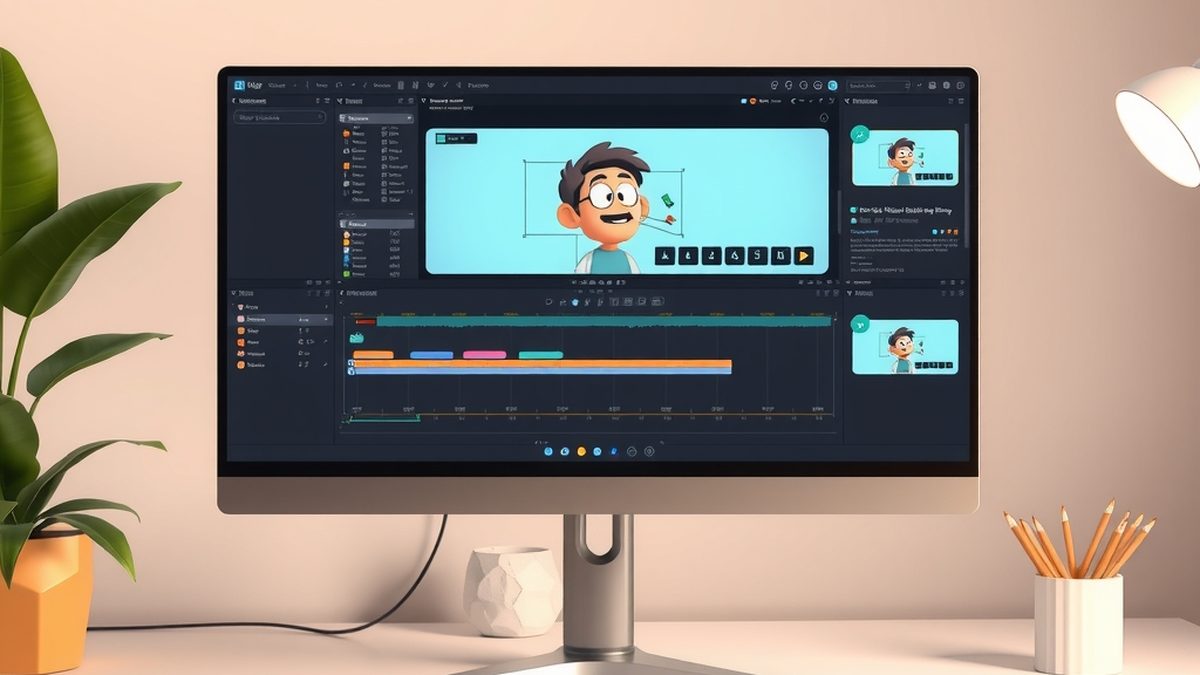
Illustration generated by Nexulab. Inline photo via Pexels
- For tweened vector animation and cut-out rigging, Synfig Studio is the closest free match to what Animate does best.
- For frame-by-frame hand-drawn animation, OpenToonz is the strongest open-source option by a wide margin.
- Tahoma2D is a friendlier build of OpenToonz that removes much of the learning curve.
- Pencil2D is the easiest way to start if you have never animated before and want to draw frames today.
- Blender's grease pencil does 2D inside a 3D world, which is powerful but overkill for simple vector work.
Adobe Animate is the modern name for Flash, and it is still the tool a lot of people picture when they think of 2D vector animation. The timeline, the tweens, the bone tool, the ability to draw a shape and make it move between two keyframes — that workflow is what Animate is built for.
The complication is that Animate is really two tools sharing one interface. The first tool is a vector animator: you draw shapes, set keyframes, and the software interpolates the motion between them. The second tool is a character rigger: you build a puppet from separate parts, add bones, and animate the puppet rather than redrawing it. Both use the same timeline, but they are different jobs with different needs.
No free program replaces both halves equally well, in the same way that the best free alternative to After Effects depends on whether you composite or animate text. The right choice depends on which job you actually open Animate for.
For tweened vector animation: Synfig Studio
Synfig Studio is the free tool that feels most like Animate for the vector-tweening workflow. It draws with vectors, it animates with a timeline and keyframes, and it interpolates the motion between them automatically — the same idea as Animate’s motion tweens.
The advantage is that Synfig is a dedicated 2D vector animation program. It was built for exactly the job that Animate is famous for, and it has the features to match: bone-based rigging, a library of gradients and filters, and the ability to animate a puppet made of parts rather than redrawing each frame.
The trade-off is the interface. Synfig is capable but not polished, and its curve editor and keyframe system take real time to learn. It does not hold your hand the way a commercial product does, and the documentation is thinner. But if you already understand how tweening works in Animate, the concepts transfer — you are learning where the buttons are, not what the software is doing.
What it suits: vector tweening, cut-out rigging, motion graphics with drawn shapes, and anyone who uses Animate primarily for its timeline and tweening.
For frame-by-frame drawing: OpenToonz
OpenToonz is the strongest open-source tool for hand-drawn, frame-by-frame 2D animation. It is the descendant of the software used on several well-known animated films, released as open source, and it has the feature set of a serious production tool: onion skinning, a full raster and vector workflow, exposure sheets, and scanning tools for paper animation.
The difference from Animate is philosophical. Animate works by drawing shapes and letting the software interpolate between them. OpenToonz works by drawing frames, one after another, with the computer helping you see the previous and next frames through onion skinning. If your animation is about drawing, OpenToonz is the better tool. If it is about tweening, it is not.
The trade-off is the learning curve. OpenToonz is powerful and famously demanding, with a dense interface and a manual that assumes you already know animation terminology. It rewards the time you put in, but it does not reward it quickly.
What it suits: traditional hand-drawn animation, frame-by-frame work, and anyone who draws every frame rather than tweening.
Tahoma2D: OpenToonz with the sharp edges filed off
Tahoma2D is a fork of OpenToonz with a friendlier interface and a gentler learning curve. It keeps the core engine but reorganises the workspace, simplifies the setup, and removes some of the most intimidating parts of OpenToonz for a newcomer.
The trade-off is that it is a smaller project with a smaller community, and it tends to lag behind OpenToonz on new features. For most people starting frame-by-frame animation, that trade is worth it: you get most of the power without most of the frustration, and if you outgrow it, everything you learned transfers directly to OpenToonz.
What it suits: beginners who want OpenToonz-level power without the full learning curve.
Pencil2D: the simplest way to start animating
Pencil2D is the free tool for someone who has never animated before and wants to draw moving pictures today. It has a timeline, a drawing canvas, and onion skinning, and almost nothing else. That minimalism is the point.
The trade-off is that Pencil2D does not do tweening or rigging. You draw every frame by hand. For learning how animation works, that is a feature — you understand the craft because nothing is being done for you. For producing finished vector animations with smooth interpolated motion, it is not enough.
What it suits: beginners, learning animation, short hand-drawn pieces, and anyone who wants to start drawing frames in the first hour.
Blender’s grease pencil: 2D inside a 3D world
Blender does 2D animation through its grease pencil feature, which lets you draw strokes directly in a 3D scene. It is genuinely capable, and it has a real advantage no other tool on this list has: you can mix 2D drawing and 3D objects in the same shot, which opens up effects that are difficult or impossible in a flat 2D program.
The trade-off is that Blender is a 3D application first. Its interface, its workflow and its mental model all assume you are working in three dimensions, and the grease pencil is a feature bolted onto that. If your work is 3D-adjacent or you already know Blender, it is powerful. If you want to tween a simple vector shape, it is far more machinery than the task needs.
What it suits: 2D-and-3D mixed shots, Blender users, and animation that needs depth.
The comparison: which free tool fits which job
| Tool | Animation style | Rigging | Learning curve | Best for |
|---|---|---|---|---|
| Synfig Studio | Vector tweening | Yes | Moderate | Animate-style tweens and cut-out rigs |
| OpenToonz | Frame-by-frame | No | Steep | Traditional hand-drawn animation |
| Tahoma2D | Frame-by-frame | No | Moderate | OpenToonz power without the frustration |
| Pencil2D | Frame-by-frame | No | Gentle | Beginners and learning |
| Blender grease pencil | 2D in 3D space | Yes | Steep | Mixed 2D/3D shots and Blender users |
The honest bottom line
The best free alternative to Adobe Animate is the one that matches how you animate. If you open Animate to draw a vector shape and tween it across the screen, Synfig Studio is the closest free match. If you open it to draw characters frame by frame, OpenToonz is the stronger choice. The two jobs are different enough that no single free program wins both.
The one thing none of these tools replicate is the ability to open existing Animate and Flash files. That format is proprietary, and if your work depends on a library of old projects, that is a stronger reason to keep the subscription than any feature comparison. Be honest about that before you switch.
For most people starting fresh, the path is simple: if you want to tween, learn Synfig. If you want to draw, learn Pencil2D first and graduate to Tahoma2D or OpenToonz when you hit its limits. And if you are drawing the vector assets for your animation in the first place, the best free alternative to Adobe Illustrator is a separate decision that pairs naturally with whatever animation tool you choose.
Frequently asked questions
What is the best free alternative to Adobe Animate?
It depends on the job. If you use Animate for tweening vector shapes and rigged cut-out animation, Synfig Studio is the closest structural match. If you use it for frame-by-frame hand-drawn animation, OpenToonz is the stronger choice. Animate is two tools wearing one interface, and no single free program replaces both halves equally well.
Is there a free program that opens Flash or Animate files?
No. Flash and Animate files are a proprietary format, and there is no free tool that reliably opens them. Some file exporters can pull out individual assets, but the timeline, tweens and rigs do not transfer. If you have a library of old Flash projects that clients expect you to update, that is a legitimate reason to keep the subscription, and it is worth being honest about that before switching.
What replaced Flash when it was discontinued?
Nothing replaced Flash directly. Browsers removed the Flash plugin, and Adobe renamed the authoring tool to Adobe Animate, which now exports to HTML5 canvas and video rather than the old Flash format. The open web moved to HTML5, JavaScript and CSS for interactive content, and the animation community scattered across several tools. That is exactly why there is no single obvious replacement and this article compares them by job.
Can Blender replace Adobe Animate?
Blender can do 2D animation through its grease pencil feature, and it is genuinely capable. But it approaches the problem from a 3D application, which means the interface and workflow carry far more machinery than a vector animation task needs. If your work is 3D-adjacent or you already know Blender, grease pencil is powerful. If you just want to tween a bouncing ball, it is the long way around.
Which free animation tool is best for beginners?
Pencil2D. It is a simple frame-by-frame drawing tool with a timeline and an onion-skinning view, and it has almost nothing else to learn. That minimalism is the point: you can draw and animate in your first hour. It will not do tweening or rigging, but for learning how animation works before committing to a bigger tool, it is the lowest-friction starting point.