The Best Free Alternatives to Adobe Photoshop
Photoshop is four programs wearing one name. Once you work out which of the four you actually use, the free replacement becomes obvious — and in one case, better.
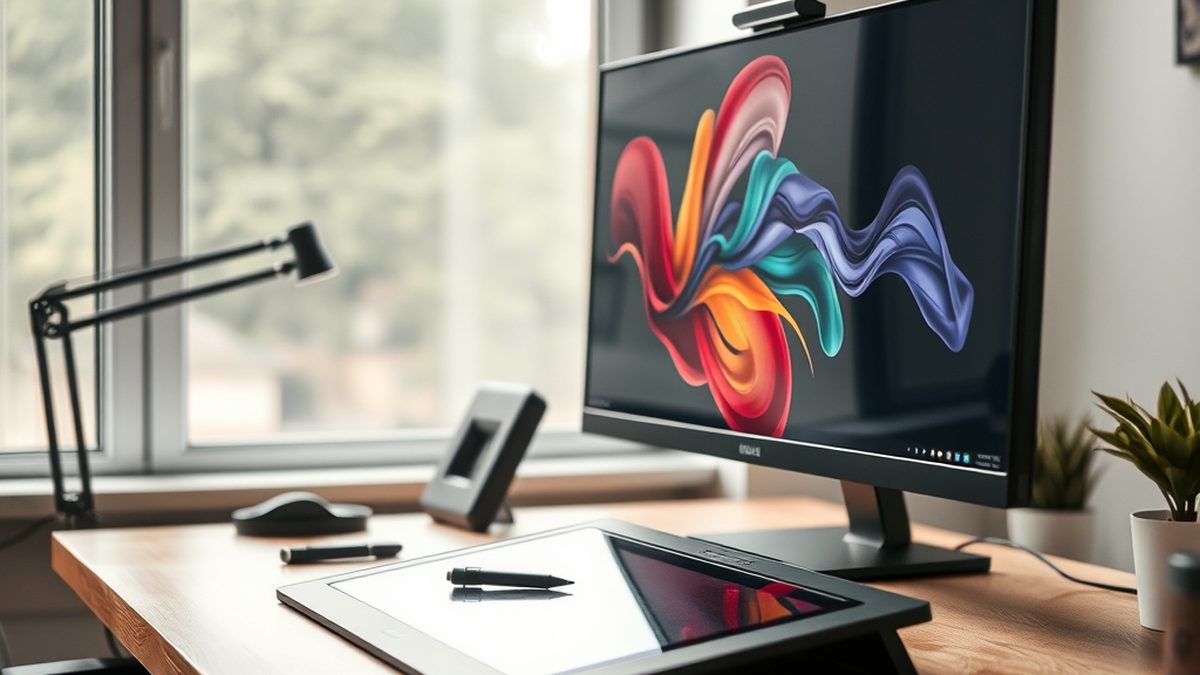
Illustration generated by Nexulab
- There is no single replacement for Photoshop, because Photoshop does four unrelated jobs. Pick by job, not by reputation.
- For photo retouching and compositing, GIMP is the closest free equivalent and handles layers, masks and non-destructive edits.
- For digital painting, Krita is not a compromise — many illustrators prefer it to Photoshop outright.
- For a quick edit with no installation, Photopea runs in the browser and opens PSD files with layers intact.
- CMYK prepress and colour-managed print production remain the one area where free tools genuinely fall short.
Before choosing between free alternatives to Adobe Photoshop, it helps to notice something about Photoshop itself: it is not one program. It is four, sold together.
It is a photo retoucher. It is a digital painting application. It is a page-layout and compositing tool for web graphics. And it is a print production tool with colour management and CMYK separation. Most subscribers use one of those four seriously and the other three barely at all.
That matters because no free program replaces all four, and every article that tries to name one winner ends up recommending a poor fit for most readers. Work out which of the four you actually open Photoshop for, and the answer becomes straightforward.
For photo retouching and compositing: GIMP
GIMP is the closest thing to a general-purpose Photoshop replacement, and it has been for a long time. Layers, layer masks, paths, channels, curves, healing and clone tools, perspective transforms, batch processing through a scripting console — the structural features are all present.
Two things about it are worth saying plainly.
The interface is not Photoshop’s, and that is the real cost. Muscle memory does not transfer. Tools live in different places, some keyboard shortcuts differ, and a few operations take an extra step. If you have used Photoshop daily for a decade, the first week is genuinely irritating. That irritation is the price, not a missing feature.
It handles PSD files, imperfectly. Layers usually survive. Smart objects, live adjustment layers and some layer styles do not have direct equivalents, so complex production files can lose structure on import. For your own work, start and finish in GIMP and this never comes up.
Where it stops: CMYK. GIMP works in RGB internally, and while plugins exist for separation, this is not a tool for sending files to a commercial printer with predictable colour.
For digital painting: Krita
If you draw, this is not a compromise. Krita was built for painting from the beginning, funded and developed with input from working illustrators, and in several respects it is simply better suited than Photoshop for the job.
The brush engine is deep and the presets are genuinely good out of the box. Canvas rotation and mirroring are first-class. There is a wrap-around mode for tiling textures, a pop-up palette that keeps your eyes on the canvas, and a frame-by-frame animation timeline.
It is free, open source, and runs on Windows, macOS and Linux.
Where it stops: it is not a photo editor. The retouching and correction tools are thin by comparison, and it has no interest in being a layout tool. Use it for what it is.
For a quick edit right now: Photopea
Photopea runs in a browser tab, opens PSD files with layers, and looks close enough to Photoshop that most of your habits transfer directly. No installation, no account required for basic use.
It is the honest answer to a large share of real Photoshop tasks: crop this, remove that, adjust these levels, export as PNG.
Two caveats. It is ad-supported, and the ads are visible. And your file is processed in the browser rather than uploaded to a server — good for privacy, but it means performance depends on your machine and very large files can struggle.
For RAW photography: darktable or RawTherapee
If what you actually use is Lightroom rather than Photoshop, these are your options, and they are strong ones.
darktable organises itself as a non-destructive processing pipeline: your edits are instructions applied to an untouched original, in an order you can inspect and reorder. It has a catalogue for managing a library, and its colour handling is well regarded.
RawTherapee covers similar ground with a different emphasis — more granular control over demosaicing and noise reduction, less interest in library management.
Where they stop: both expose the machinery. Sliders are named after what they actually do rather than after the effect you want, which makes the first hour confusing and the tenth hour productive. Neither is trying to be friendly.
Quick comparison
| What you do | Free tool | Runs offline | Main trade-off |
|---|---|---|---|
| Retouch and composite photos | GIMP | Yes | Unfamiliar interface; no real CMYK |
| Draw and paint | Krita | Yes | Weak photo-editing tools |
| Quick edit, open a PSD | Photopea | Browser-based | Ad-supported; large files strain it |
| Develop RAW files | darktable, RawTherapee | Yes | Steep initial learning curve |
| Print production, CMYK | No solid free option | — | See below |
The one job that still needs paying for
Colour-managed print production. Not “make a PDF” — that is easy. Producing a file with correct CMYK separation, ink limits and spot colours, in a form a commercial printer will accept and reproduce predictably.
Free tools either do not handle this or handle it in a way that produces surprises at the press. If you are sending work to print for money, that single capability justifies a subscription. Everything else on this page does not.
How to decide in a minute
Open Photoshop and look at what you do in the next ten minutes.
Moving pixels around a photograph? Install GIMP. Give it a week before judging it.
Drawing with a stylus? Install Krita and stop thinking about Photoshop.
One small fix on a file someone sent you? Open Photopea, do it, close the tab.
Processing camera RAW files? darktable, and accept a learning curve.
Sending files to a printer? Keep paying.
For most people the honest outcome is a combination — GIMP plus Photopea covers a surprising amount — and the subscription becomes something you cancel rather than something you replace.
For more in this series, see our other software & tools guides.
Frequently asked questions
Is there a free version of Photoshop?
No. Adobe offers a free trial and a limited free tier of Photoshop on the web, but the full desktop application is subscription-only. Any site offering a free permanent download of the complete version is distributing cracked software, which typically arrives with modified code you cannot inspect. The legitimate free route is a different program, not a free Photoshop.
Can GIMP open PSD files?
Yes, and it usually preserves the layer structure, which is the part that matters. What it handles less reliably are Photoshop-specific features with no GIMP equivalent: certain layer styles, smart objects, adjustment layers with live filters, and some blend modes. A simple layered PSD opens cleanly. A complex production file may flatten parts of itself on the way in.
What do professional illustrators use instead of Photoshop?
Many use Krita or Procreate rather than Photoshop, because Photoshop was built for photographs and had painting features added later. Krita's brush engine, canvas rotation, wrap-around mode and animation timeline were designed for drawing from the start. It is free and open source, and for illustration specifically it is not a downgrade.
Which free photo editor is best for RAW files?
darktable and RawTherapee both develop RAW files non-destructively, the way Lightroom does, and both give you finer manual control than most paid consumer software. The trade-off is a steeper start: their interfaces expose the underlying processing pipeline rather than hiding it. If you shoot RAW and want to learn properly, that exposure is an advantage.
Are free image editors safe to download?
Download from the project's own website rather than a software aggregator, and the answer is yes. The risk with free software is almost never the software itself — it is third-party download portals that wrap legitimate installers in bundled adware. Go to the official domain, and ignore search ads above the real result.