Why Do Cats Hate Water? It Is Not What You Think
Most cats avoid water, and the common explanation — instinct — only gets halfway there. The real reasons are physical, and they make sense of the exceptions.
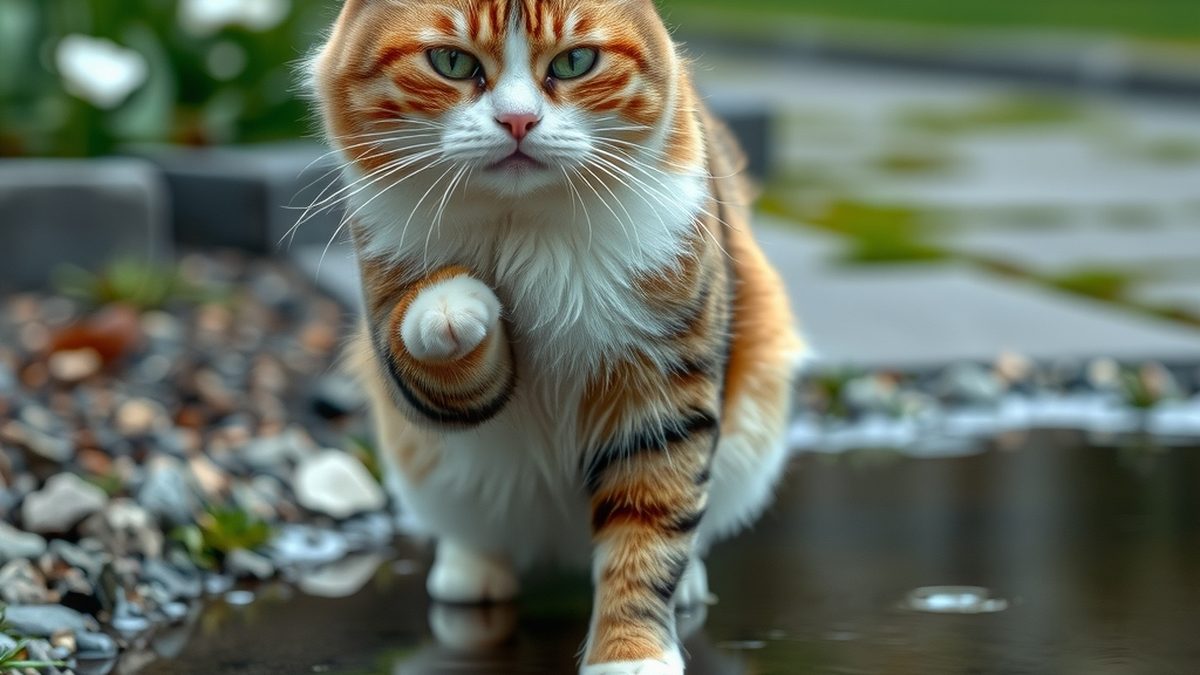
Illustration generated by Nexulab
- A cat's coat absorbs water rather than repelling it, which makes the animal heavier, colder, and less agile — a triple disadvantage for a predator that relies on speed.
- Heat loss through a wet coat is rapid, and cats have a higher thermal neutral zone than humans, so what feels like a mild chill to us is genuinely uncomfortable to them.
- Loss of control matters: a cat in water cannot retreat quickly, and for an animal whose primary defence is flight, that is stressful at a deep level.
- Early exposure changes everything. Kittens handled gently around water from a young age often tolerate or even enjoy it as adults.
- Some breeds — Turkish Van, Maine Coon, Bengal — have coat structures that resist water better, and their behaviour around water reflects that difference.
Most cats avoid water, and most explanations stop at instinct. The domestic cat descended from the African wildcat, a desert animal, and therefore — the story goes — it never learned to tolerate water. That is true as far as it goes, but it does not explain why a cat that has never set foot in a desert will panic at a filled bathtub. The real answer is physical, and it makes sense of the exceptions.
A cat's coat absorbs water instead of repelling it. That makes the cat heavier, colder, slower and more vulnerable — four things a predator that relies on speed and agility cannot afford. The aversion is not a personality quirk. It is physics.
The coat: why water sticks
A cat’s fur is structured for insulation, not for repelling water. Each hair has a rough outer cuticle that traps air against the skin, creating a warm layer that keeps the cat comfortable across a wide range of temperatures. Air is an excellent insulator, and the cat’s coat works by holding it in place.
Water collapses that system. When the fur gets wet, the air pockets fill with water instead, and the coat becomes dense, heavy and cold. A soaking wet cat weighs significantly more than a dry one, and the extra weight sits on the whole body, making movement sluggish.
For an animal whose hunting strategy depends on explosive acceleration and precise balance, that is a meaningful disadvantage. A wet cat cannot jump as high, cannot turn as sharply, and cannot run as fast. In the wild, those few seconds of slowness could mean the difference between catching a meal and going hungry, or between escaping a threat and being caught.
The thermal cost matters just as much. Cats have a higher thermal neutral zone than humans — the temperature at which the body does not need to work to stay warm. A wet coat in a room that feels comfortable to a person can still cause a cat to lose heat faster than it can produce it, and the sensation is genuinely unpleasant.
Fur density and the breed exceptions
Not all coats are equal, and the difference explains why some cats are far less bothered by water.
| Breed | Coat characteristic | Behaviour around water |
|---|---|---|
| Turkish Van | Single coat with a cashmere-like texture, no undercoat, dries fast | Known as the swimming cat; seeks out water voluntarily |
| Maine Coon | Double coat with a water-resistant outer layer, evolved for snowy wet climates | Tolerates water well, often plays in it |
| Bengal | Short, dense pelt-like coat with minimal undercoat, dries quickly | Frequently wades and plays in shallow water |
| Typical domestic shorthair | Dense undercoat, no water-resistant outer layer | Avoids water, coat becomes heavy and cold when wet |
| Persian | Very dense long coat, heavy undercoat | Strong aversion, the coat becomes extremely heavy when wet and takes a long time to dry |
The pattern is clear: breeds with coats that shed water or dry quickly tend to be the ones that tolerate or seek it out. Breeds with dense absorbent coats avoid it. The behaviour follows the physics.
Why dogs are different
The comparison with dogs comes up often, and it helps clarify what is really going on. Many dogs will run into a lake or a river without hesitation, and some genuinely love swimming.
The difference begins with the coat. Many dog breeds have a double coat with an outer layer that is oily and water-repellent. Water beads and runs off rather than soaking through to the skin. Retrievers, spaniels and other water-working breeds were selected for exactly this trait, and their coats are purpose-built for getting wet.
Body size also plays a role. A medium or large dog has a lower surface-area-to-volume ratio than a cat, which means it loses heat more slowly when wet. A Labrador coming out of a cold lake shakes off and carries on. A cat of a tenth the mass, with a soaked-through coat, loses heat fast and stays cold.
There is also an evolutionary angle. Dogs descend from wolves, which crossed rivers during hunts and dispersed across continents by swimming. The domestic cat’s wild ancestor, the African wildcat, lived in semi-arid environments where standing water was rare. The aversion was not selected against because there was no pressure to overcome it.
The control problem
A cat’s primary defence is flight. When something is wrong, a cat runs, climbs or hides. Water removes all three options. A cat in deep water cannot sprint, cannot climb, and cannot retreat to a safe perch. The only way out is to swim, and swimming is slow and exhausting for an animal not built for it.
This loss of control is stressful at a deep neurological level, similar to what happens when a cat is overstimulated during petting — the nervous system crosses a threshold and behaviour tips from calm to defensive in seconds. The same cat that will sit for hours batting at a dripping tap — engaging with water entirely on its own terms, with a clear exit available — will panic when placed in a tub where the water is deep, the surface is slippery and there is no way out.
That is also why a cat that falls into water accidentally often reacts with far more panic than one that steps in voluntarily. The startle combines with the loss of control, and the stress response amplifies both.
Early experience rewrites the script
The default aversion is strong, but it is not immutable. Kittens exposed to water gently and positively in the first weeks and months of life often grow into adults that tolerate water far better than cats without that experience.
The key is that the exposure must be gradual and never forced. A kitten placed in shallow warm water for a few seconds and rewarded with food or play learns that water is not a threat. A kitten dunked or sprayed learns the opposite — and the lesson sticks harder because fear consolidates more durably than calm.
This is consistent across many species. Early positive exposure to a novel stimulus reduces the adult fear response, and early negative exposure amplifies it. With cats, the default is already tilted towards avoidance, so negative experiences compound quickly.
For an adult cat that already fears water, the window for easy change has largely closed. The goal becomes management: making unavoidable baths as brief, warm and calm as possible, with a non-slip surface under the paws and a high-value reward at the end.
When a bath is unavoidable
Most cats never need a bath. They groom themselves fastidiously, and their tongue and saliva are adapted for cleaning the coat. A healthy indoor cat stays clean without human intervention.
Baths become necessary in a few specific situations: when the cat has gotten into something toxic or sticky that it should not ingest through grooming, when a medicated shampoo has been prescribed for a skin condition, or when a long-haired or elderly cat can no longer groom itself effectively.
In those cases, making the experience as brief and stress-free as possible matters for both the cat and the person:
- Use warm water, not hot or cold. Test it on your wrist the way you would for a baby.
- Place a non-slip mat or a folded towel in the bottom of the tub or sink so the cat has traction.
- Fill the water before bringing the cat into the room. The sound of running water adds stress.
- Keep the water shallow — a few centimetres is enough, and the cat does not need to be submerged.
- Work quickly and calmly. Talk to the cat in a low steady voice.
- Rinse thoroughly and dry immediately with a thick towel. A wet cat in a cool room will shiver, and shivering means the bath has already gone on too long.
Do not use a hairdryer unless the cat has been desensitised to it beforehand — the noise alone is enough to undo whatever calm you managed to preserve.
Reading the body language
A cat that is stressed around water does not hide it well, and the signals are worth knowing. Flattened ears, a thrashing tail, dilated pupils and a crouched low posture all indicate fear. Vocalisation during stress tends to be lower-pitched than a normal meow — a long low growl or yowl rather than a short high mew.
If the cat begins to pant or breathe with an open mouth, stop immediately. Panting in a cat is not normal the way it is in a dog, and it signals extreme stress that can escalate to a medical problem.
A cat that is merely displeased but not panicked will have its ears forward or slightly sideways, its tail still, and its body posture upright. It may try to leave but will not thrash. This is the best you can hope for with an unwilling cat, and it is a sign that the bath is tolerable.
The evolutionary story, in full
The domestic cat’s wild ancestor, Felis silvestris lybica, lived across North Africa and the Middle East, in landscapes where water was scarce and mostly still. The species did not need to cross rivers regularly, did not hunt in water, and did not face pressure to evolve a water-resistant coat.
Contrast that with the fishing cat of South and Southeast Asia, a wild felid that hunts in water and has a double-layered coat that traps a layer of warm air against the skin when submerged. Or the jaguar, which swims across wide rivers and hunts caiman. Water aversion in cats is not universal across the family Felidae. It is specific to the lineage that led to the domestic cat, and it reflects the environment that shaped it.
The domestic cat’s behaviour around water is not a failure of adaptation. It is exactly what you would expect from an animal whose ancestors had no reason to get wet, whose coat is optimised for dry insulation, and whose survival strategy depends on staying light, fast and in control.
For further reading on feline behaviour and coat health, the ASPCA’s cat care section covers a wide range of common cat-care topics, and the Cornell University College of Veterinary Medicine offers detailed resources on feline health and development from kittenhood through old age.
Frequently asked questions
Is it true that all cats hate water?
No, but most do. The exceptions are instructive. Some individual domestic cats will wade into shallow water voluntarily, and a few swim. Certain breeds — the Turkish Van, the Maine Coon, the Bengal — have a reputation for tolerating or even seeking out water. The Turkish Van in particular is sometimes called the swimming cat. What these exceptions share is a coat that dries faster and insulates better when wet. The aversion is physical before it is anything else.
Why do cats hate water but dogs like it?
Coat structure is the biggest difference. Many dog breeds have a double coat with an oily outer layer that sheds water, and dogs evolved from wolves that crossed rivers during hunts. Cats descend from the African wildcat, a desert species that rarely encountered standing water. Add to that the thermal difference — a dog's larger body retains heat better when wet — and the gap in enthusiasm makes physical sense without needing to invoke personality.
Can I train my cat to like water?
You can train a cat to tolerate water, and in some cases to accept it calmly. The window is kittenhood: gentle exposure to shallow warm water, paired with positive reinforcement and never forced, produces adult cats that are far less reactive. With an adult cat that already fears water, the goal is management rather than conversion. Make unavoidable baths as brief and warm as possible, use a non-slip mat, and reward heavily afterwards. Do not expect enthusiasm.
Why does my cat play with water from the tap but hate the bath?
Control. A dripping tap or a shallow stream is something the cat chooses to interact with, on its own terms, with a clear exit route at all times. A bath removes all of that: the cat is placed into deep water, cannot leave, and loses traction on the slippery surface. The same cat that bats at a running tap will panic in a tub because the context is entirely different.
Is being wet dangerous for a cat?
In most indoor situations, no — but it can be if the cat gets cold and cannot dry off. A wet cat in a draughty room or outdoors in cool weather loses heat quickly, and kittens, elderly cats and thin-coated breeds are at more risk. After an unavoidable bath, dry the cat thoroughly with a towel and keep it in a warm room until the coat is no longer damp. If the cat is shivering, it has already been wet too long.