Why Does My Dog Follow Me Everywhere?
Being shadowed from room to room is flattering, and most of the time it means nothing more than that you are the most interesting thing in the house. The exception matters, though.

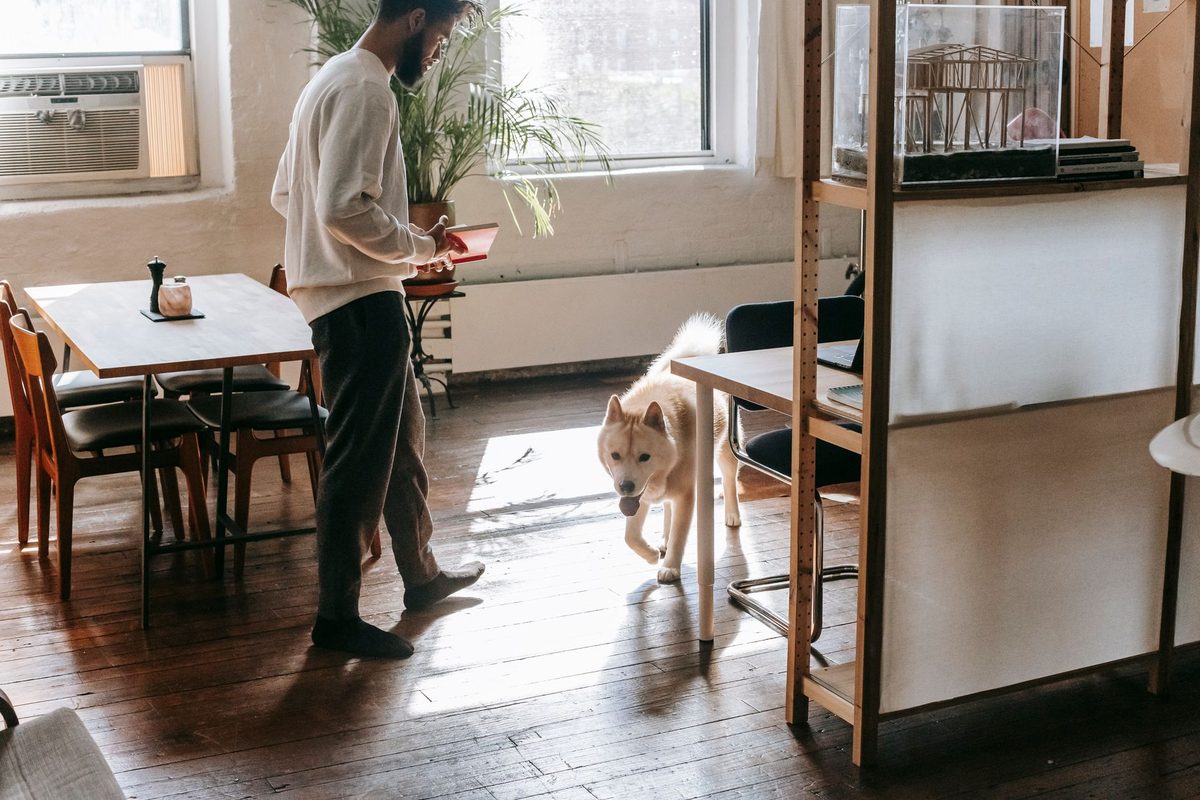
Illustration generated by Nexulab
- Following is normal social behaviour in a species that evolved to live in groups and stay with them.
- You have almost certainly reinforced it without meaning to. Movement predicts interesting events, and dogs learn that fast.
- The distinction that matters is not how closely they follow you but how they behave when you are gone.
- Distress on separation is a different problem from attachment, and it does not improve by being ignored.
- A sudden change in a dog that was previously independent is worth a vet visit before a training plan.
Ask why does my dog follow me everywhere and the answers arrive in two flavours: it is pure love, or it is separation anxiety.
The first is sentimental and mostly harmless. The second is a real condition that gets applied far too widely, usually to dogs that do not have it.
What is actually going on is simpler, and the interesting part is not why they follow you. It is what happens when they cannot.
This is general information, not veterinary advice. A sudden change in behaviour, or genuine distress when left alone, deserves a vet or a qualified behaviourist rather than an article.
The ordinary explanation
Dogs are a social species. The whole shape of dog behaviour reflects a history of living in groups and staying with them, and you are the group.
Then add three practical things.
You are the most interesting thing in the house. You open doors, produce food, pick up leads, make noise, and leave. Everything that happens to a dog is downstream of what you do. Watching you is not devotion so much as excellent information strategy.
Movement predicts events. You standing up has, across the dog’s whole life, preceded meals, walks, attention, and departures. Following you is how they find out which one it is this time. That is learning working exactly as it should.
You reinforced it. Not deliberately. But the dog comes with you, and in the kitchen something falls, and on the sofa you stroke them, and by the door there is sometimes a walk. Behaviour that intermittently pays off is the hardest kind to extinguish — more persistent than behaviour rewarded every time.
None of that is a problem. A dog that keeps you company is doing what dogs do.
The line that matters
Here is the distinction worth learning, because it is the one that separates a devoted dog from a dog that needs help.
How closely they follow you tells you almost nothing.
How they cope when you leave tells you everything.
A closely attached dog trails you from room to room, lies down near you, gets up when you get up — and then, once the front door closes, sighs and goes to sleep. That dog is fine. It likes company. It is not suffering.
A dog with separation distress cannot settle at all. It paces, vocalises, drools, chews at doors and windows, or soils indoors despite being reliably house-trained. It may begin to unravel while you are still putting your shoes on.
Those are different situations that look identical while you are at home.
How to find out
Record it. This is genuinely the only reliable method, and it takes one afternoon.
Set a phone or a camera facing the area the dog usually stays in, leave the house as normal, and stay away for thirty minutes. Then watch the footage.
What you are looking for is the first ten minutes. Most dogs are unsettled for a few minutes and then lie down. If yours settles by minute five and sleeps, you have your answer and can stop worrying.
If the pacing, whining or scratching is still going at minute twenty-five, that is not attachment. That is a dog that cannot cope, and it responds to a structured plan rather than to being left more often.
The ASPCA publishes accessible material on separation-related behaviour, and veterinary teaching hospitals such as Cornell University College of Veterinary Medicine cover the medical side of behavioural change.
When following is new
This deserves its own paragraph because it is the case most often mishandled.
A dog that was independent for years and has suddenly become a shadow is telling you something different from a dog that has always been this way.
Worth considering:
- Pain or illness. Staying close to you is a sensible response to feeling unwell.
- Failing sight or hearing. A dog losing a sense uses you as the reliable reference point.
- Cognitive decline in older dogs, which often shows as increased clinginess and night-time restlessness.
- Household change — a move, a new pet, a new baby, a change in your schedule.
For a sudden onset with no obvious trigger, a vet comes before a trainer. Behaviour is often the first visible symptom of something physical.
If you want a bit more space
Not because the behaviour is wrong, but because a dog that can settle independently is a dog that copes better with everything.
Build a good place to be. A bed somewhere the dog can still see the room, made genuinely comfortable. Reward them for choosing it — food dropped there while they are lying calmly, not called over and then rewarded.
Reward settling, not following. The moment they lie down of their own accord is the moment worth noticing. Most owners only give attention when the dog is at their feet, which teaches exactly what they are trying to undo.
Make your movement less predictive. Stand up, walk to the kitchen, do nothing, sit back down. Repeat until getting up stops being a signal. This is dull and it works.
Give the day some structure. A dog with a predictable walk, predictable meals and something to chew has less reason to monitor you for clues.
Do not shut them out abruptly. Closing a door on a dog that has never been alone teaches that separation is sudden and unpleasant. Build up in short, calm intervals instead.
And never punish it. Following you is frequently about seeking security — the same reason punishing a dog for licking you tends to backfire. Punishing a dog for seeking security produces a less secure dog, which follows more.
The short version
A dog that follows you everywhere and then sleeps when you leave is a dog that likes you. That is the whole story, and it needs no intervention.
A dog that cannot be alone has a different problem, one that will not resolve by being tolerated — and thirty minutes of video will tell you which of the two you have.
For more in this series, see our other pets guides.
Frequently asked questions
Is it bad if my dog follows me everywhere?
On its own, no. Dogs are social animals and staying near their group is ordinary behaviour, not a disorder. It becomes worth addressing when the dog cannot settle unless you are present, panics when you leave, or has stopped doing things it used to enjoy independently. The behaviour is not the problem; an inability to cope without you is.
What is the difference between a velcro dog and separation anxiety?
What happens when you actually go. A closely attached dog follows you around, then settles reasonably well once you are out of the house. A dog with separation distress cannot settle at all — it may pace, vocalise, drool, destroy things near exits, or house-soil despite being trained. The clearest way to tell is to record the first thirty minutes after you leave and watch it.
Why does my dog follow me to the bathroom?
Because you went somewhere and they came with you, which is the whole logic. Dogs do not share the human sense that some rooms are private, and a closed door is simply a barrier between them and their group. If the door is shut and they wait outside it calmly, nothing is wrong. If they scratch and panic, that is the same separation question in miniature.
Should I stop my dog from following me?
There is no need to stop it, and trying to can make things worse if the underlying reason is insecurity. What is worth building is the ability to settle independently — a comfortable place to rest, rewarded for being used, so that staying put becomes a choice rather than a punishment. You are adding an option, not removing one.
Why has my dog suddenly started following me everywhere?
A change in a previously independent dog deserves more attention than long-standing behaviour. Illness, pain, failing eyesight or hearing, and cognitive decline in older dogs can all produce new clinginess, because staying close to you is a sensible response to feeling vulnerable. Household changes matter too. If it appeared abruptly, start with a vet rather than a trainer.