Why Does My Cat Lick Me? It Is Not Just Affection
A rough tongue on your hand can feel like pure affection, and often it is. But the same behaviour also carries messages about territory, routine and emotional state that are worth knowing if you live with a licker.
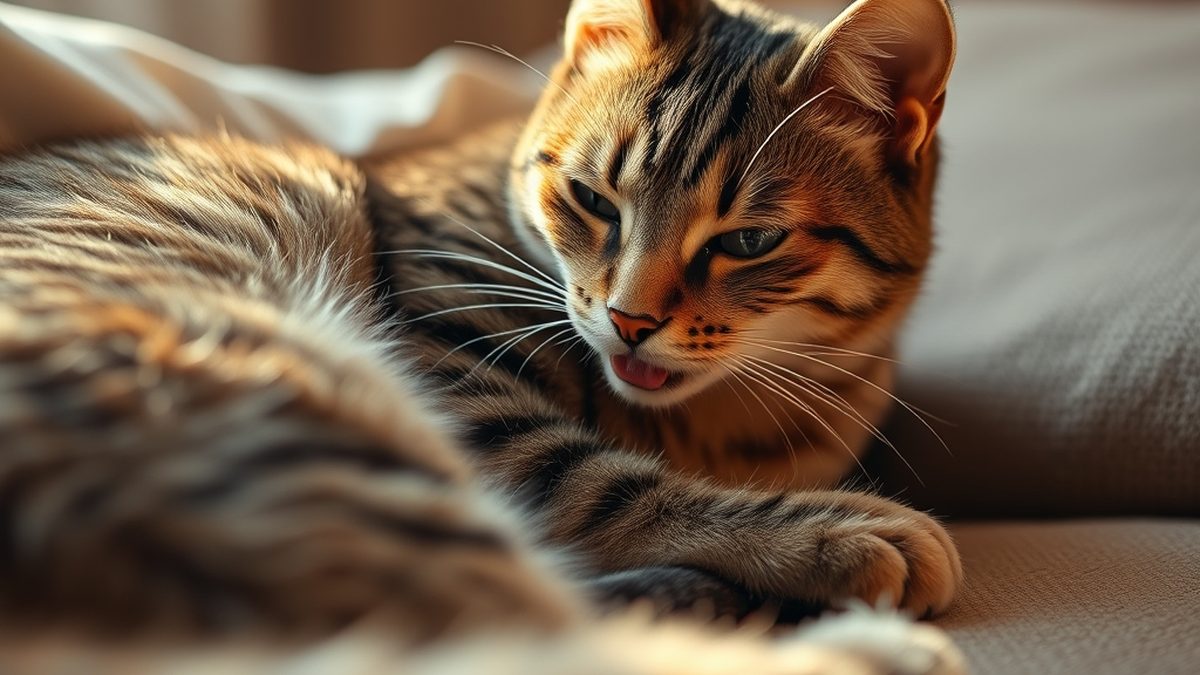
Illustration generated by Nexulab
- Licking is a social behaviour rooted in kittenhood: the mother licks her kittens to clean them and to bond, and that imprint lasts.
- Cats also lick to mark territory. The scent glands in the mouth deposit a chemical signature that says you belong to their social group.
- A cat that licks excessively may be anxious, bored, or seeking sensory stimulation. Licking releases endorphins that temporarily soothe.
- Read the whole body, not just the tongue. A relaxed licker is different from one that licks while tense, restless or hiding.
- If licking becomes compulsive — raw patches on the cat's own fur or your skin — it is worth a veterinary check.
A cat’s tongue feels like warm sandpaper, and when it comes without warning during a quiet moment on the sofa, most people read it as a straightforward sign of love. The gesture is not wrong — affection is often part of it — but the story is wider than that, and knowing the rest of it changes how you read your cat.
Licking is one of the earliest experiences a kitten has. Before its eyes open, before it can hear, it knows the sensation of the mother’s tongue: grooming, guiding, stimulating. That tongue is not random. It signals safety, warmth and belonging. When the same cat grows up and turns that tongue on you, it is reaching for the same register.
The kittenhood imprint
A mother cat licks her kittens for reasons that have nothing to do with affection in the human sense and everything to do with survival. In the first hours after birth, licking removes the amniotic fluid so the kitten can breathe. After that it serves three ongoing functions: hygiene, stimulation of bodily functions a newborn cannot yet control, and the formation of a shared scent that identifies the litter as a single unit.
Kittens separated too early — before eight to ten weeks — often carry an exaggerated version of this oral behaviour into adulthood. Without the full weaning period and the gradual distancing that a mother cat naturally enforces, the kitten never fully outgrows the association between licking and security. For cats like these, licking you really is comfort-seeking. It is not quite affection in the human meaning. It is closer to a regression to the safest state the cat has ever known.
Cats that stayed with their mother into adolescence still lick, but they tend to do it in shorter bursts and with more discernible triggers. For them it is one social tool among several, not the dominant one.
The scent-sharing system
Cats live in a world organised by smell, and licking is one of the ways they manage that world. A cat’s mouth contains scent glands — concentrated around the lips, the gums and the front of the palate — that deposit a chemical mark on whatever the tongue touches.
When a cat licks your hand, it is not just tasting salt or lotion. It is laying down a scent that says, in feline terms, this person is part of my social group. The same mechanism is at work when cats lick each other, a behaviour called allogrooming. Two cats that sleep together and groom each other are not just being friendly. They are creating a colony scent, a shared chemical identity that helps distinguish friend from intruder.
The implication for a human owner is straightforward. If your cat licks you and another cat in the household does not, the licker is not necessarily more affectionate. It may simply have a stronger drive to define the group scent, and your hand is the nearest surface.
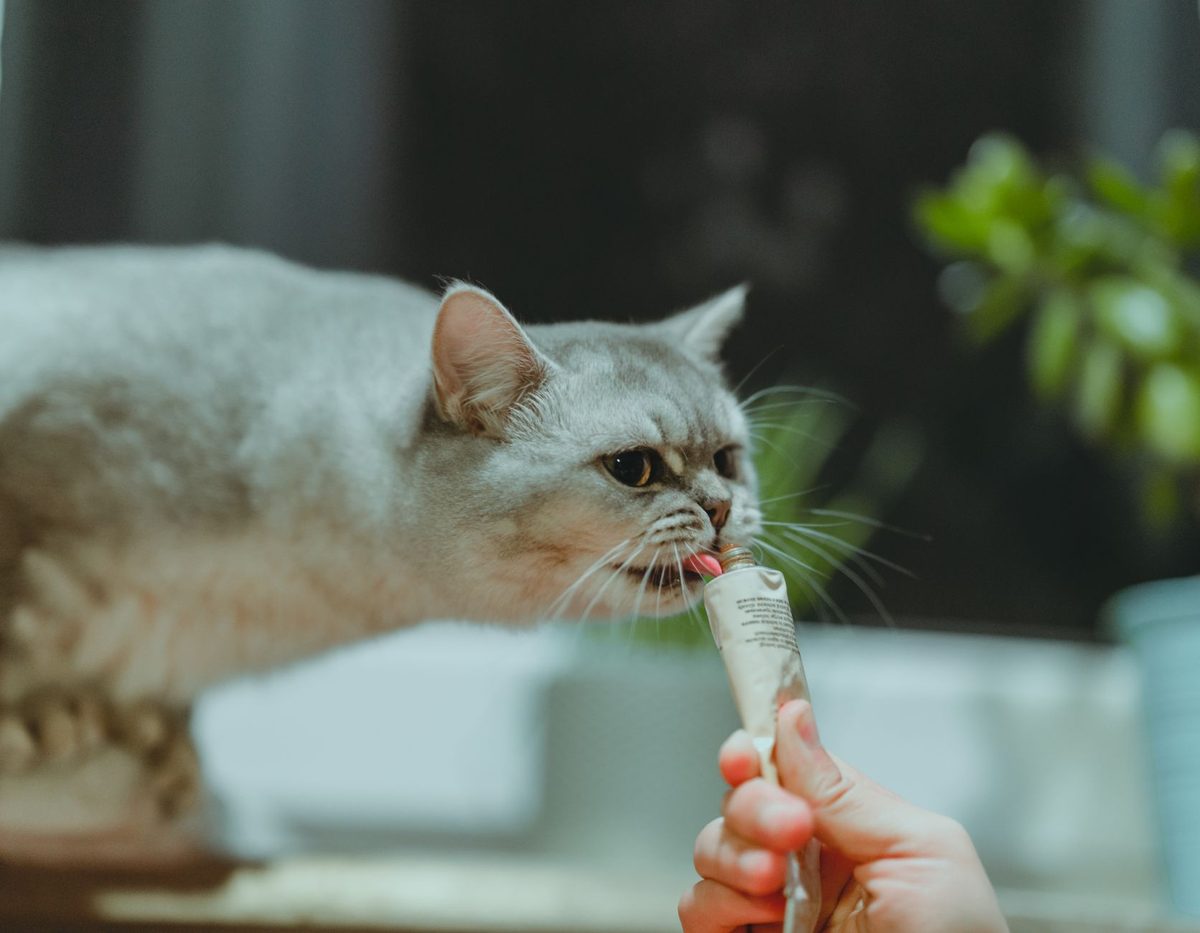
When licking means stress
Not all licking is social. Some of it is closer to a nervous habit, and the distinction matters because the response is different.
Licking releases endorphins — the same endogenous opioids that make grooming feel soothing to many mammals. A cat that is mildly anxious can use licking to bring its arousal level down, much as a person might fidget with a pen or bite a fingernail. The behaviour works: the endorphin release is real. The problem is that it can become compulsive.
The difference between social licking and stress licking is visible in the rest of the body. A social licker is usually relaxed: ears forward or neutral, eyes soft or half-closed, body loose against yours. A stress licker is more rigid. The ears may twitch and rotate, the tail may flick, and the licking is often directed at a single spot with a repetitive, almost mechanical quality. Sometimes the cat will lick itself instead — often the belly, the inside of the legs, or the base of the tail — until the fur thins or the skin reddens.
If you notice the mechanical pattern, do not punish it. The cat is not being difficult; it is trying to manage an internal state it does not fully control. The useful questions are practical ones. Has something in the house changed recently — a new person, a moved litter box, a different feeding schedule? Is the cat getting enough active play earlier in the day, so that the arousal has somewhere to go before it turns inward?
The salt-and-routine explanation
Sometimes the simplest explanation is the right one, and for a lot of cats the simplest explanation is this: human skin tastes interesting. Sweat contains sodium, and a cat whose diet is marginally low in sodium may find the taste rewarding enough to seek it out. Lotions, soaps and even the faint residue of food on your fingers add variety to the experience.
Once the behaviour is established, it becomes self-reinforcing for a second reason. If every time the cat licks you, you respond — you look at it, you stroke it, you talk to it — the cat learns that licking produces attention. Attention from a bonded human is one of the most powerful reinforcers in a domestic cat’s environment. The cat does not need to understand cause and effect the way a person does. It only needs the sequence: licking leads to something good.
This is why ignoring the behaviour, consistently and for several days, is the most effective way to reduce it. It is also the hardest to do, because a rough tongue on the back of the hand at six in the morning demands a reaction. But every reaction, even a negative one, is still a reward in the cat’s learning loop.
Reading the licking context
| What the cat is doing | What the body looks like | What it most likely means |
|---|---|---|
| Licking your hand in short, gentle strokes while curled beside you | Ears forward, eyes half-closed, purring may be present | Social bonding and scent-sharing; the cat is content in your presence |
| Licking the same spot on your arm or leg repetitively, for minutes at a time | Body tense, ears rotating, tail flicking intermittently | Anxiety or overstimulation; the cat is self-soothing through the behaviour |
| Licking your face or hair at dawn | Alert posture, possibly accompanied by walking across you or meowing | A learned wake-up behaviour, reinforced by your response over time |
| Licking immediately followed by a soft nibble or bite | Relaxed before the lick, brief tensing at the moment of the bite, then relaxation again | Grooming sequence spillover; the cat is treating your hand like a companion’s fur |
| Licking its own fur compulsively, with barbering or bald patches | Hunched posture, may hide or retreat afterwards | Stress, allergy or underlying medical condition — warrants a veterinary visit |
| Licking the air or smacking lips when you are not touching them | Normal posture otherwise | Nausea or dental discomfort; watch for other signs like reduced appetite |
How to manage excessive licking without damaging the bond
The instinctive human reaction to being licked too much is to pull away and say no. With most cats, that does not work as intended. The cat does not understand the verbal correction, and the sudden withdrawal of contact can feel like rejection to an animal that uses proximity as its primary measure of security.
What works better is redirection. When the licking starts and you would rather it did not continue, offer a substitute surface that is still linked to you: a folded piece of your clothing, a soft brush, a toy that smells of your hands. Stroke the cat with that object instead of letting it lick your skin. The cat still gets the social contact and the familiar scent; it just does not get it through the tongue.
If the licking is clearly stress-driven, address the cause rather than the symptom. A cat that lacks vertical space — shelves, cat trees, window perches — may be carrying a background level of anxiety that comes out through the mouth. A cat that gets ten minutes of interactive play a day may simply have energy with nowhere to go. The licking is the visible part of a larger picture.
And if the licking suddenly intensifies, changes character or moves from you to the cat’s own body, consult a veterinarian. Compulsive grooming in cats can be triggered by pain, allergies, hyperthyroidism or neurological conditions, and the earlier these are treated the better the outcome. The ASPCA cat care resources offer a useful starting point for understanding when a behaviour crosses from normal to concerning.
Why some cats never lick at all
It is worth saying, because owners of non-licking cats sometimes wonder whether the absence means something is wrong. It does not. Licking is one social behaviour among many, and cats express affiliation in different ways. Some cats slow-blink instead. Some follow you from room to room but never make physical contact. Some head-butt — bunting, the technical term — using the scent glands on the forehead, which serve the same marking purpose as licking without the tongue.
A cat that does not lick you is not withholding affection. It is simply using a different vocabulary. The important question is not whether your cat licks, but whether its social behaviour — whatever form it takes — is consistent over time. A cat that used to greet you at the door and has stopped, or that used to sleep on your bed and now hides under it, is communicating something worth investigating. The specific gesture matters less than the change.
The same applies in reverse. A cat that has always licked occasionally may start licking more because it has discovered that you taste of a new moisturiser. That is not a behaviour problem; it is a cat being a cat. Watch the pattern, not the isolated moment.
When licking is linked to purring
Licking and purring often appear together, and the combination can be misleading. A purring cat is not always a happy cat — purring also occurs during stress, injury and veterinary visits. The two behaviours share a similar emotional range. Both originate in kittenhood as signals to the mother, and both carry into adulthood as flexible communication tools that serve different purposes in different contexts.
A cat that licks your hand while purring in a relaxed sprawl on your lap is giving you a fairly unambiguous signal of contentment. The same cat, licking the same hand while purring in the tense crouch of a carrier on the way to the vet, is doing something else: self-soothing through a frightening situation. The purr is the same sound. The lick is the same gesture. The meaning has flipped.
This is why reading body language matters more than reading the individual behaviour. Ears, eyes, whiskers, tail and posture together form a sentence. A lick or a purr alone is only a word, and words need context.
The grooming-bite link
Owners often notice that licking and gentle biting go together, and the pairing can be confusing. In feline social grooming, the sequence is not lick-only. Cats grooming each other alternate between licking and small nibbles, using the incisors to remove debris or parasites from the fur. It is a functional pattern, not an emotional one.
When a cat applies the same sequence to human skin, the result can be startling — the sudden teeth after the soft tongue — but the cat is not switching emotions. It is running a grooming programme that was shaped by evolution for fur, not skin. The bite is usually inhibited: enough pressure to register, not enough to break the skin. If the cat is otherwise relaxed, this is a quirk of instinct, not a warning.
If the bite is harder, if it is accompanied by flattened ears or dilated pupils, the licking was probably overstimulation and the bite is a signal to stop. Pay attention to where the cat’s tolerance threshold sits, and end the session before you reach it. Most cats give subtle signals — a twitching tail, a slight pull of the skin on the back — before they escalate to teeth.
Is cat saliva harmful?
The question often comes up, and the answer requires a distinction. Cat saliva is not sterile, but on intact human skin it is generally harmless. The risks cluster in specific situations.
The bacterium most commonly associated with cat saliva is Pasteurella multocida, which resides in the mouths of most healthy cats without causing them any trouble. Introduced into human tissue through a puncture or a wound, however, it can cause an infection that develops rapidly — sometimes within hours — with redness, swelling and pain. People with compromised immune systems, including those undergoing chemotherapy or taking immunosuppressive drugs, are at higher risk.
The sensible precautions are not dramatic. Wash your hands after a licking session if you have any broken skin. Do not let a cat lick your face near your mouth or eyes, where mucous membranes offer an easier route in. And if a cat does break the skin — with a bite, not a lick — wash the wound thoroughly with soap and water and watch it carefully. Most minor cat bites heal without complication, but the ones that do not tend to escalate quickly, and early medical attention makes a significant difference.
Frequently asked questions
Why does my cat lick me and then bite me?
This sequence, so common it has its own reputation, is usually overstimulation rather than a mixed signal. The licking begins as a social gesture, but the repetitive sensation can tip a cat's nervous system past its comfort threshold. The bite — almost always a gentle inhibited bite rather than an aggressive one — is the cat's way of saying it has had enough. Some cats also do it as part of a grooming routine they would perform on another cat: lick, nibble, lick. If the bite is hard or the ears go flat, the cat is genuinely irritated. If it is soft and the cat stays relaxed, it is probably just a grooming habit that landed on human skin.
Why does my cat lick me so much?
Excessive licking usually points to one of three things. The cat may have been weaned too early and missed the full separation from the mother, leaving a stronger-than-usual oral fixation. It may be using licking as a self-soothing mechanism in response to stress — a new home, a new pet, a change in routine. Or it may simply have learned that licking gets a reaction: if you talk to the cat, stroke it back or laugh each time, the behaviour is reinforced. Watch whether the licking is more frequent when the house is quiet or when something has recently changed; that tells you which direction to investigate.
Is cat saliva clean?
No. A cat's mouth carries bacteria, some of which are specific to cats and can cause infection in human skin if they enter a wound. Pasteurella multocida, the most common, is present in the mouths of most healthy cats and can cause a rapidly developing infection after a scratch or bite. A lick on intact skin is generally harmless. A lick on broken skin, a surgical wound or the face near the mouth is not. This is one reason the [ASPCA recommends](https://www.aspca.org/pet-care/cat-care) washing any area a cat has licked if the skin is compromised.
Why does my cat lick my face at night?
Cats are crepuscular, meaning they are most active around dawn and dusk. If your cat licks your face while you are asleep, it is often trying to wake you — not for affection, but because its own internal clock says it is time to be up. The face is the warmest, most exposed part of you and the part that moves when you react. If the cat has learned that licking your face gets you out of bed to feed it, the behaviour is now a trained one. The only reliable way to stop it is to stop responding: do not get up, do not feed, do not speak. The cat will try harder before it tries less, but if the reward disappears, the behaviour eventually fades.
Should I let my cat lick me?
For most healthy adults with intact skin, occasional licking is harmless and can be a valuable form of social contact that your cat understands. The exceptions are worth knowing. Do not let a cat lick a baby or toddler, whose immune system is less equipped to handle even ordinary feline mouth bacteria. Do not let a cat lick an open wound, a healing incision or a skin condition. And if you use topical medications, creams or cosmetics on your skin, check whether any of the ingredients are toxic to cats: some common ones, including certain retinoids and salicylates, are absorbed through the mouth and can cause harm.